

Global Industrial Energy Dynamics and Infrastructure Investment Cycles
The international industrial landscape is increasingly stressed by escalating energy costs, aging infrastructure, and the challenge of remaining competitive. As utility monopolies confront the dual pressures of fulfilling public service mandates and achieving financial sustainability, the Eskom power tariff initiative aimed at supporting South Africa’s ferrochrome sector highlights the complexities encountered in modern industrial policies.
Strategic Resource Dependencies in Global Supply Networks
Continental Chromite Resources and Geopolitical Implications
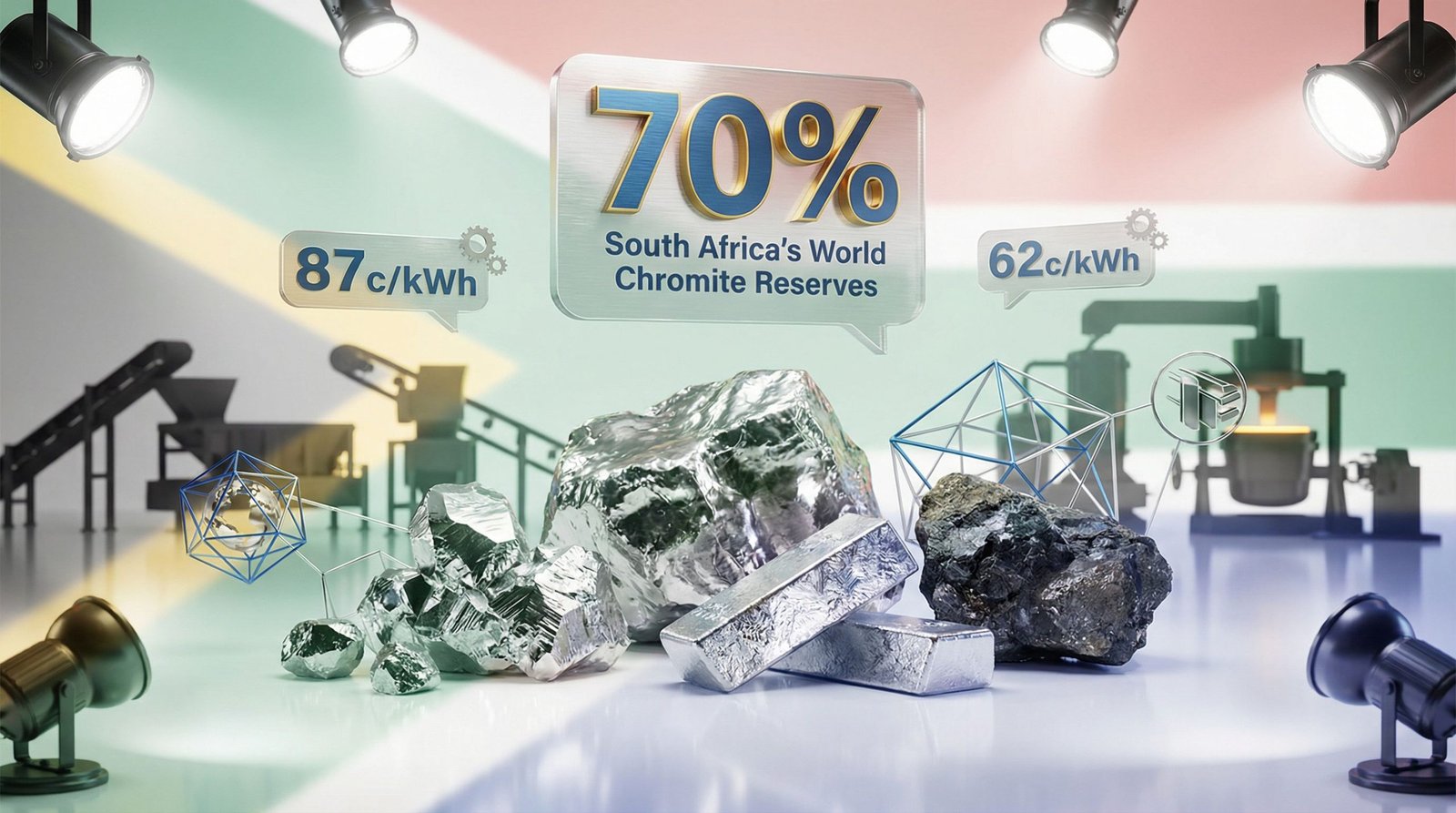
South Africa’s dominance in the global chromite market—holding approximately 70% of the world’s reserves—positions it as an essential supplier for stainless steel production. The country’s geological formation, known as the Bushveld Igneous Complex, is home to the largest known chromite deposits and precious metals. Consequently, this concentration creates systemic reliance for key players in steel production such as ArcelorMittal, Nippon Steel, and POSCO, who have limited alternatives from countries like Kazakhstan, Turkey, or India.
Moreover, an analysis on energy pricing reveals how such policies can significantly impact global competitive dynamics across industrial sectors.
Economic Multiplier Effects in Mining-Dependent Regions
The role of ferrochrome production extends beyond direct manufacturing; it initiates substantial economic activity in several ways:
- Transport logistics: Enhancing rail and port infrastructure.
- Supporting services: Encompassing maintenance, equipment supply, and consulting.
- Regional spending: Circulating worker wages into local economies.
- Tax revenues: Contributing municipal rates, provincial royalties, and national corporate taxes.
- Skills development: Engaging in training programs and enhancing engineering capabilities.
The 1,500 direct jobs at Glencore Merafe Chrome Venture merely scratch the surface; job losses in the mining sector often lead to an impact of 3-5 times through disruptions in the supply chain and decreased regional purchasing power.
Power Intensity Requirements for Ferrochrome Smelting
The smelting of ferrochrome is one of the most energy-intensive manufacturing processes globally, requiring between 3.2-4.5 MWh per tonne of the final product. The process involves operating electric arc furnaces at temperatures exceeding 1,650°C, where electricity can account for 40-50% of the production costs. This dependency on consistent high-voltage electricity means that policy changes in pricing can destabilize operations, making resilience to energy market fluctuations critical.
South African Electricity Tariff Evolution and Industrial Competitiveness
The fluctuating tariffs from Eskom, South Africa’s main power utility, reflect the mounting financial difficulties faced by the utility, significantly impacting industrial customers.
| Year | Industrial Tariff (c/kWh) | Annual Escalation | Cumulative Increase |
|---|---|---|---|
| 2014 | 9.7 | Baseline | 0% |
| 2018 | 35.2 | 262% | 263% |
| 2022 | 72.1 | 105% | 643% |
| 2026 | 87.0 | 21% | 797% |
This 797% cumulative increase over a twelve-year period dwarfs inflation rates and exemplifies the pressing need for extensive capital investments in the aging coal-fired fleet, now burdened with a R230 billion debt.
Competitive Benchmarking Against Global Ferrochrome Producers
Comparing electricity prices reveals South Africa’s growing competitive disadvantage:
- Norway: 4–6 c/kWh (advantage of hydroelectric power)
- Canada: 6–8 c/kWh (supportive provincial structures)
- Kazakhstan: 3–5 c/kWh (coal-based generation)
- Turkey: 12–15 c/kWh (diverse energy portfolio)
- India: 8–12 c/kWh (hybrid of coal and renewables)
Even with a reduced rate of 62 c/kWh, South African producers are still facing costs 10-15 times higher than their international counterparts, thereby jeopardizing export competitiveness.
Employment Protection Through Negotiated Pricing Mechanisms
Direct Employment Impact Assessment
The Eskom power tariff aimed at saving South African ferrochrome has preserved 1,500 jobs at Glencore Merafe Chrome Venture. These roles are crucial, including:
- Smelter operators with expertise in furnace management
- Electrical technicians skilled in high-voltage systems
- Process engineers specializing in metallurgy
- Quality control specialists versed in international standards
- Logistics coordinators managing export supply chains
Regional Economic Dependencies and Skills Profiles
Ferrochrome operations in regions like Limpopo and North West provinces are pivotal employers in areas with few industrial alternatives, leading to unique challenges in workforce transitions due to the specificity of electrometallurgical skills.
Mining facility closures can lead to a reduction in local GDP by 15-25% in single-industry towns, with recovery taking 5-7 years even with successful economic diversification.
Export Revenue Implications and Balance of Payments Dynamics
Ferrochrome Export Performance and Foreign Exchange Generation
Ferrochrome exports contribute approximately R25–30 billion annually to South Africa’s foreign exchange reserves, stabilizing the current account and bolstering the rand during periods of low commodity prices.
Loss of this critical revenue would exacerbate current account pressures, especially where competitiveness in manufacturing and service exports is at stake.
Competitive Positioning Against Emerging Producers
Emerging economies are becoming serious competitors in the ferrochrome market, notably:
- Kazakhstan: Increasing capacity with Chinese investments
- India: Expanding local production to meet domestic stainless steel demand
- Turkey: Utilizing strategic geographic advantages for European market access
- Indonesia: Integrating nickel-chrome production platforms
These players obtain benefits from modernized facilities, lower energy costs, and sometimes government incentives, further diminishing South Africa’s competitiveness.
Regulatory Architecture for Negotiated Pricing Agreements
Eskom’s NPA Framework Structure and Approval Process
The Negotiated Pricing Agreement (NPA) framework, overseen by the National Energy Regulator of South Africa (NERSA), guides negotiations for deviations from standard tariffs. According to Eskom, the five-year cap aims to avoid permanent pricing favoritism that could influence market equilibrium.
Key elements of the framework include:
- Case-specific evaluations based on economic impacts
- Transparency measures through public consultations
- Assessments of Eskom’s financial sustainability
- Prioritization of sectors yielding the highest employment impact
- Regulatory coherence with wider energy policy objectives
Financial Engineering Behind Discounted Industrial Tariffs
The 62 c/kWh tariff presents a 29% decrease from the regular 87 c/kWh, necessitating careful financial engineering to keep Eskom’s finances intact. Yet, there are concerns about undisclosed measures that could potentially lead to cross-subsidization or unacknowledged government support.
Industrial Policy Precedents and International Comparisons
Energy-Intensive Industry Support Mechanisms Globally
Globally, other nations have set precedents for supporting energy-intensive industries, including:
- Norway: Long-term energy contracts for aluminum at 3-4 c/kWh
- Canada: Provincial arrangements for mining sectors
- Australia: Customized tariffs for aluminum and steel
- Iceland: Attractive geothermal pricing for energy-intensive sectors
These cases demonstrate a tendency of governments to prioritize industrial retention as part of broader economic development strategies.
Sectoral Prioritisation Framework Development
Eskom’s acknowledgment of prioritizing ferroalloy and steel sectors reflects strategic importance based on potential job losses, revenue generation, dependency on mining-focused provinces, the need to preserve specialized skills, and supply chain connections to broader manufacturing entities.
Long-Term Sustainability and Energy Transition Considerations
Renewable Energy Integration Opportunities for Industrial Applications
South Africa’s wealth in solar and wind resources could enable hybrid energy models that lower production costs while assuring grid reliability. Notably, Concentrated Solar Power (CSP) technology holds promise for consistently powering energy-intensive operations.
Investment necessities for this transition involve:
- On-site renewable energy implementations
- Upgrades in grid infrastructure
- Modifications in production processes
- Enhancing workforce skills for hybrid energy management
Industrial Competitiveness and Economic Development Integration
The future of the ferrochrome sector hinges on a synchronized industrial policy addressing:
- Beneficiation of value chains
- Infrastructure upgrades in rail, ports, and energy
- Technical education programs to safeguard industries
- Streamlined regulatory processes
- Investment incentives to attract new capital
What Risks Face the Long-term Viability of This Agreement?
Utility Financial Sustainability Versus Industrial Support Objectives
The conflicting demands of Eskom’s debt repayments and the necessity to retain industrial clients present ongoing policy challenges. Although the R230 billion debt relief package extends short-term fiscal breathing room, sustainable utility viability may necessitate tariffs that are unsustainable for energy-intensive industries.
Alternative Scenarios for South African Ferrochrome Industry
Scenario 1: Successful Industrial Retention
- Adoption of renewable energy leads to cost reduction.
- Increased downstream investment boosts local production.
- Development of regional industrial clusters around ferrochrome facilities.
Scenario 2: Gradual Industry Migration
- Potential facility closures occur despite temporary pricing relief.
- Production capacity shifts towards lower-cost international options.
- Skills and capital transition to competing markets.
Scenario 3: Technology-Driven Transformation
- Innovations minimize energy requirements.
- Hybrid renewable systems enhance cost competitiveness.
- Efficient operational structures emerge through industry consolidation.
Investment Strategy Implications and Market Psychology
Investor Sentiment and Industrial Equity Valuations
The Eskom tariff initiative momentarily stabilizes ferrochrome equity valuations, yet foundational challenges remain. Glencore’s market position epitomizes prevailing concerns over South African industrial competitiveness and the dependability of government interventions.
Key considerations for investors include:
- Regulatory risks regarding potential tariff hikes beyond the five-year agreement
- Competitive threats from lower-cost international producers
- The risk of technological obsolescence and evolving manufacturing methods
- Currency fluctuations impacting revenue from exports
- Political stability across electoral changes
Portfolio Diversification Strategies for Resource Investors
The ferrochrome sector’s challenges illustrate the importance of geographic diversification to mitigate utility price risks. Consideration of investments in companies innovating for energy-efficient production may yield advantageous positioning.
Ultimately, the fate of the Eskom tariff initiative for ferrochrome will depend on the broader socio-economic transformation and the successful implementation of sustainable energy pricing frameworks that adequately balance industrial competitiveness and the viability of utility operations.
Explore Investment Opportunities in Resource-Dependent Industries
Discovery Alert’s proprietary Discovery IQ model provides real-time alerts on significant ASX mineral discoveries, aiding investors in identifying emerging opportunities within sectors undergoing structural changes like ferrochrome and other industrial minerals. Uncover how major mineral discoveries have historically delivered considerable returns during transitional phases, and start your 14-day free trial today to stay informed on market advancements.
