
Nigeria’s Digital Transformation: A Call for Collaboration Between Government and Startups
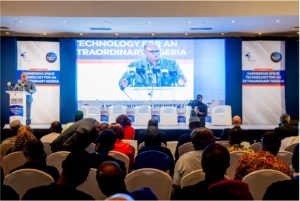
The National Information Technology Development Agency (NITDA) has initiated a major discourse on the essential collaboration between government institutions and emerging startups for Nigeria’s digital transformation. At the recent Nigerian Satellite Week 2026 in Abuja, Kashifu Inuwa, the Director General of NITDA, emphasized this critical partnership during the theme “Harnessing Space Technology for an Extraordinary Nigeria.”
Importance of Collaboration in Innovation
Inuwa urged stakeholders to recognize the value of partnerships as a means to foster innovation and productivity. He quoted, “Take a good step, and you can make a difference,” pointing out that collective efforts are crucial in turning innovative ideas into real-world applications. His message, delivered by Aristotle Onumo, the Director of Stakeholder Management and Partnerships at NITDA, outlined key principles to drive societal transformation:
- Enable ecosystem growth rather than imposing control.
- Prioritize networking over institutional hierarchy.
- Develop talent while fostering innovation and practical solutions.
- Focus on platforms instead of isolated projects.
Success Stories of Digital Innovation
Inuwa illustrated his points by sharing a success story of a rural farmer who enhanced productivity through access to digital tools. This narrative highlights the transformative power of digital innovation and space technology in driving broader economic growth and improving national infrastructure, including satellite systems.
The Role of Startups in Nigeria’s Space Technology Sector
Startups are taking a leading role in innovation across sectors such as telecommunications, navigation, security, and cloud services. Once dominantly controlled by superpowers, space technology is now recognized as a vital economic driver, with Nigeria’s “Sunrise Packet” expected to contribute over $1.5 billion to the economy by 2030.
Inuwa stressed, “Innovation without adoption is wasted,” highlighting the government’s role in providing supportive policies and infrastructure needed for startups to thrive. He urged that developmental regulations should foster market creation and public value rather than inhibit innovation. Noteworthy initiatives supporting this growth include the Digital Start-Up Act, Idea Hatch, and the National Digital Leadership Programme, all aimed at empowering the youth and promoting global visibility.
Government Investment in Space Technology
Also at the event, Tijani, the Minister of Communications, Innovation and Digital Economy, underscored the importance of Nigeria’s unique satellite infrastructure. He pointed out that Nigeria is the only country in West Africa with its own satellite, highlighting NigComSat’s role in providing vital connectivity.
Tijani revealed that President Bola Ahmed Tinubu has approved the acquisition of two new satellites, NigComSat-2A and NigComSat-2B, designed to enhance national space capabilities. However, he stressed the importance of effectively leveraging this technology to benefit agriculture, education, security, and the business sector.
Expanding Nigeria’s Digital Infrastructure
To support further advancements in the digital economy, the government has earmarked ₦12 billion for a digital economy research cluster fund under Project Bridge. Additional initiatives include the installation of 90,000 kilometers of fiber optic cables and nearly 4,000 telecom towers in underserved areas, aimed at improving connectivity across borders.
“The talent, ideas, and energy are all here in Nigeria. It is up to us to turn them into real outcomes for our people and the economy,” Tijani stated, emphasizing the acceleration of Nigeria’s digital transformation.
The Future of Nigeria’s Space Economy
The ongoing Nigerian Satellite Week functions as a strategic platform for collaboration among government bodies, startups, academia, and the private sector. Jane Nkechi Egerton-Ideyen, Managing Director of Nigerian Communications Satellite Limited (NIGCOMSAT), noted the significant growth of Nigeria’s space program, following key reforms and commercial partnerships resulting in revenue growth from less than $650 million in 2023 to over $2 billion in 2025.
Beyond financial gains, she highlighted the program’s commitment to improving livelihoods and inclusive development, mentioning that over 500 young Nigerians received training in satellite technology in the past year.
Conclusion: A Call for Cooperative Growth
In conclusion, the focus on collaboration among government, startups, NGOs, and investors remains pivotal for digital advancement in Nigeria. “If we are going to create a digital Nigeria, we must collaborate,” Inuwa succinctly remarked. The journey toward a robust digital economy and space sector in Nigeria is underway, powered by the collaborative spirit and untapped potential of its youthful population.