

Revolutionary Supply Chain Architecture Transforms Global Resource Dependencies
The landscape of international mineral supply networks is undergoing a profound transformation, representing one of the most consequential reorganizations in global economic patterns since traditional commodity trading emerged. Advanced manufacturing economies are realizing that resource security entails more than simple procurement strategies; it demands thorough geopolitical risk assessments and long-term strategic planning. This shift fundamentally disrupts conventional supply chain management methodologies, which previously focused primarily on cost optimization.
Modern supply chain structures are influenced by several converging factors, including technological advancements that fuel the demand for specialized materials, geopolitical tensions that reveal supplier vulnerabilities, and environmental concerns that reshape acceptable sourcing methodologies. These dynamics not only challenge traditional paradigms but also present exceptional opportunities for resource-rich nations to move beyond mere raw material extraction and establish integrated value chains.
South Africa: A Strategic Player in the Critical Minerals Supply Chain
South Africa’s emergence as a pivotal supplier in the global critical minerals market highlights how geological advantages, combined with strategic policy initiatives, can redefine international supply chains. The nation’s abundant mineral resources encompass various high-value categories vital for technological advancement and energy transition, especially within the critical minerals energy transition.
Key Strategic Minerals:
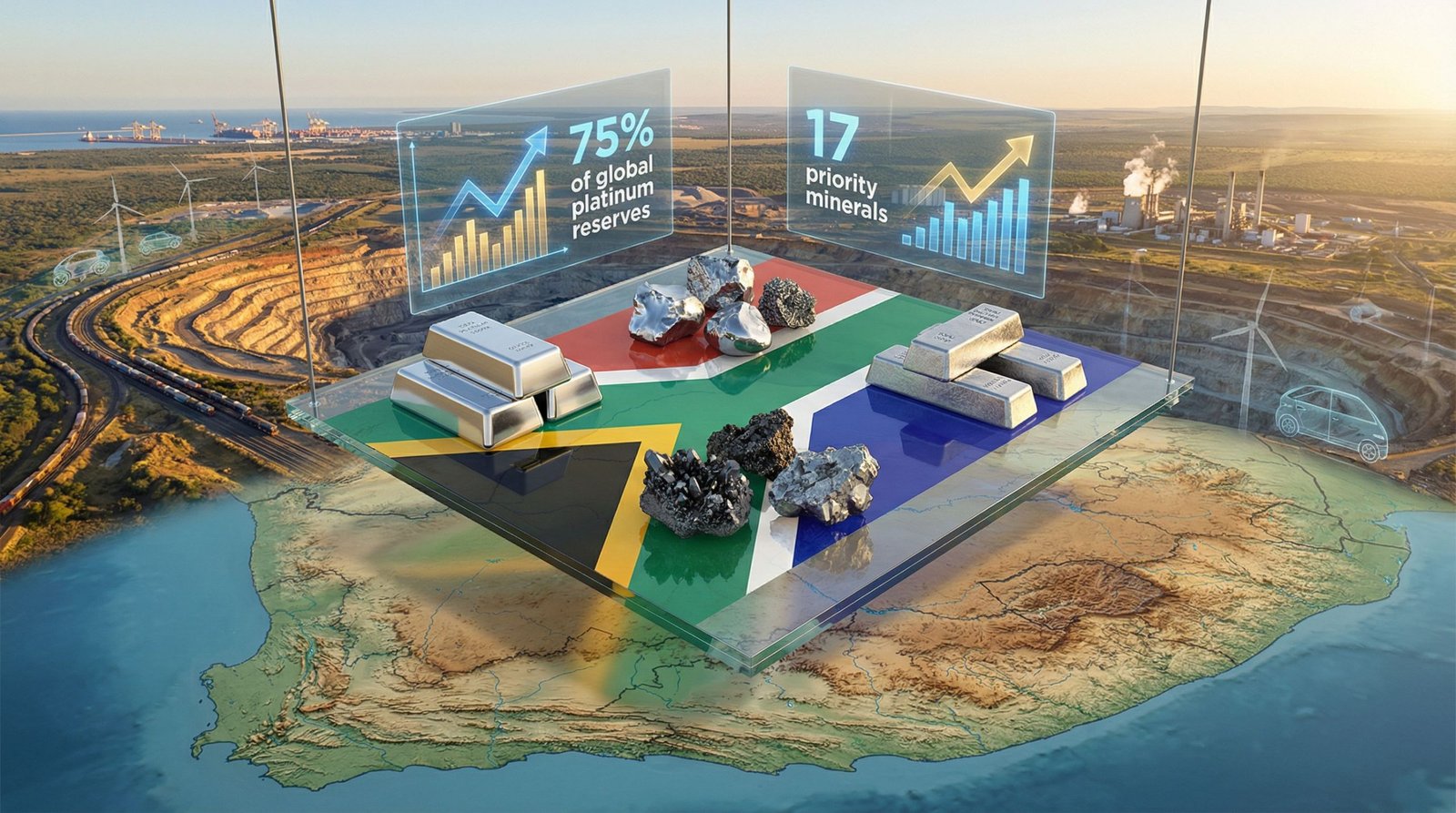
- Platinum Group Metals: Home to approximately 75% of global platinum reserves, granting substantial market leverage.
- Chromium Dominance: Supplies 79% of U.S. chromium imports, essential for stainless steel manufacturing.
- Palladium Resources: Supplies 57% of U.S. palladium, a crucial component in catalytic converter production.
- Vanadium Reserves: Significant deposits that are indispensable for grid-scale energy storage systems.
Concentration of critical minerals within one jurisdiction can lead to enhanced supply chain efficiency but also creates strategic dependencies for consuming nations, illustrating a dual-impact scenario where simplified procurement is accompanied by increased geopolitical exposure.
Geological Foundations and Resource Quality
The Bushveld Complex is one of the most significant geological formations globally for critical minerals concentration. This layered igneous intrusion includes not only the largest platinum reserves worldwide but also considerable deposits of chromium, vanadium, and other precious metals. Such geological structures enable integrated mining operations that efficiently target multiple mineral outputs from shared infrastructures.
Comparative Resource Advantages:
| Mineral Category | South African Position | Global Market Share | Strategic Importance |
|---|---|---|---|
| Platinum | Dominant producer | 75% of reserves | Hydrogen economy, automotive |
| Chromium | Primary supplier | Major global supplier | Stainless steel, aerospace |
| Manganese | Significant deposits | Regional importance | Steel production, batteries |
| Vanadium | Major reserves | Growing importance | Energy storage systems |
The Northern Cape manganese deposits rank among the world’s highest-quality ore bodies, providing cost advantages over lower-grade alternatives. Currently, the U.S. sources 100% of its manganese imports from Gabon, highlighting South Africa’s potential for diversifying future supply chains.
Competitive Infrastructure and Processing Capabilities
South Africa’s well-established mining ecosystem offers immediate scaling advantages that emerging mining regions struggle to replicate. Years of investment in infrastructure have led to integrated transportation, processing, and export systems tailored for mineral extraction and beneficiation, bolstering the broader mining industry innovation.
Key Infrastructure Assets:
- Dedicated rail corridors connecting mining districts to port facilities
- Specialized port infrastructure with mineral handling capabilities
- Processing facilities that enable value-added production beyond raw ore export
- Established power generation and water systems supporting large-scale operations
Shifting from raw material exports to processed minerals fosters substantial economic multiplier effects. Enhanced processing capabilities allow South Africa to capture value-added opportunities while offering international partners refined materials tailored to specific technical requirements.
Regional Integration Dynamics
The Southern African Development Community (SADC) enhances specialized production capabilities across multiple nations. This regional integration favors countries focusing on their comparative advantages while sharing infrastructure costs and supply chain risks.
Cross-border supply arrangements exist for certain commodities, providing templates for expanded collaboration. Additionally, regional infrastructure projects, such as transportation corridors and power generation facilities, facilitate integrated value chain development beyond individual capabilities.
Global Supply Chain Vulnerability Assessment
An analysis of international supply chains reveals concentrated dependencies that pose systemic vulnerabilities for consuming economies. The United States relies on 100% import for 11 critical minerals and substantial imports for an additional 26 materials, leading to significant exposure to supply disruptions, especially in light of the US–China trade tensions.
Critical Import Dependencies:
“The United States remains import-reliant for 37 critical minerals, with China dominating processing capacity for rare earth elements, graphite, arsenic, and tantalum.”
This concentration exposes countries to various disruption scenarios, from natural disasters affecting production zones to geopolitical conflicts restricting export access. Conversely, South Africa’s political stability and long-standing trade ties provide alternative supply channels, mitigating overreliance on single-country dependencies.
Supply Chain Resilience Metrics
Supply chain vulnerabilities extend beyond geographical concentration and encompass processing bottlenecks and transportation chokepoints. China’s dominance in rare earth processing exemplifies how downstream capabilities can create strategic dependencies despite raw material dispersion.
Processing Capacity Overview:
- Rare Earth Processing: Predominantly controlled by China
- Lithium Processing: Concentrated in a few nations despite widespread deposits
- Battery Material Supply Chains: Mostly dominated by Asian manufacturers
- PGM Refining: South Africa holds notable processing capacities
The spatial separation between mining operations and processing facilities introduces further vulnerabilities within supply chains. Nations managing both extraction and processing enjoy strategic advantages during supply disruptions.
Investment Architecture Transforming Critical Minerals Development
Current investment patterns reflect substantial shifts in how critical minerals projects are structured, financed, and managed. Traditional commodity-focused models are progressing toward integrated partnerships that prioritize long-term supply security and technology transfers, aligning with comprehensive investment strategies for 2025.
Public-Private Partnership Dynamics:
| Investment Focus | Traditional Approach | Modern Strategic Model |
|---|---|---|
| Project Financing | Commodity price-based returns | Supply security premiums |
| Technology Transfer | Limited scope | Comprehensive capability development |
| Infrastructure Development | Project-specific assets | Regional integration platforms |
| Risk Management | Market-focused hedging | Geopolitical risk mitigation |
Development finance institutions increasingly prioritize projects that showcase sustainable development outcomes alongside commercial viability. Furthermore, Environmental, Social, and Governance (ESG) criteria are becoming essential in funding approval processes, favoring operations in jurisdictions with established regulatory frameworks.
Technology Transfer Mechanisms
International partnerships increasingly integrate technology transfer arrangements, enabling resource-rich countries to develop advanced processing capabilities. These collaborations yield mutual advantages: consuming nations secure essential supplies while producing countries enhance their value-added opportunities.
Areas of focus for technology transfer may include:
- Advanced metallurgical processing techniques
- Environmental management frameworks
- Automation and digital technologies in mining
- Quality control and certification processes
Long-term supply agreements guarantee revenue certainty, facilitating sustained investment in technology and capability enhancement, often supplemented with performance standards and price mechanisms that ensure mutual benefits.
Demand Sector Analysis and Growth Projections
The growth of critical minerals demand is propelled by converging technological innovations and policy trajectories, accelerating adoption across varied economic sectors. Understanding these demand drivers is pivotal for recognizing long-term market dynamics and investment prospects, especially within the overarching critical minerals strategy.
Transformation in the Electric Vehicle Market
The shift in the automotive sector towards electric powertrains leads to unparalleled demand for platinum group metals, lithium, and rare earth elements. South Africa’s dominance in PGMs uniquely positions the nation in this transformation, particularly for fuel cell methodologies and catalytic applications.
Mineral Requirements in Automotive Technologies:
- Fuel Cell Vehicles: High platinum content for catalytic functions
- Battery Electric Vehicles: Requirement for lithium, nickel, and cobalt for efficient energy storage
- Hybrid Power Systems: Multiple critical minerals for performance
- Charging Infrastructure: Specialized materials for efficient power electronics
Platinum group metals continue to play a vital role across various automotive technologies, ensuring demand stability amidst evolving techniques.
Renewable Energy Infrastructure Needs
Manufacturing processes for wind turbines and solar panels demand specific critical minerals for their energy systems, magnets, and conductive elements. Notably, South Africa’s vanadium reserves are particularly relevant for supporting grid-scale energy storage solutions essential for the integration of renewable energy.
Vanadium redox flow batteries represent an advantageous option for energy storage, featuring long cycle life, scalability, and optimal operational flexibility. As the uptake of renewable energy amplifies, the demand for vanadium-based storage solutions is poised to escalate.
Advanced Manufacturing Requirements
Sectors including aerospace, defense, and electronics increasingly require high-purity critical minerals for specialized applications. South Africa’s advanced processing capabilities allow it to tap into these premium markets that command prices above commodity-grade materials.
Premium Application Markets Include:
- Aerospace Components: High-performance alloys and specialized materials
- Defense Systems: Critical minerals for advanced weaponry and electronics
- Semiconductor Manufacturing: Ultra-pure materials essential for chip development
- Medical Devices: Biocompatible materials and precision-engineered components
Implementation Challenges and Risk Mitigation Strategies
Infrastructure Development Challenges:
| Challenge Category | Specific Constraints | Mitigation Strategies |
|---|---|---|
| Transportation | Rail capacity limitations, port congestion | Corridor development, capacity enhancement |
| Energy Supply | Grid reliability issues, renewable integration challenges | Independent power initiatives, efficiency improvements |
| Water Resources | Operational requirements, environmental concerns | Recirculating systems, alternative sourcing |
| Skill Development | Technical gaps, training limitations | Partnerships with universities, international programs |
Optimizing Regulatory Frameworks
Delays in the approval of mining licenses and regulatory uncertainty can drastically affect project timelines and investment decisions. Streamlining the approval processes, while preserving environmental and social standards, is essential for providing a conducive environment for sustainable development.
Clear policies not only enhance investor confidence but also ensure community benefits and environmental safeguards. Furthermore, transparent regulatory pathways lower project risks and facilitate long-term planning necessary for capital-intensive mining enterprises.
Market Volatility Management
Critical minerals often experience price volatility influenced by technological advancements, policy shifts, and geopolitical developments. Dedicating efforts toward diversified market exposure and long-term supply agreements can mitigate the impacts of price fluctuations.
Strategies for Risk Management:
- Portfolio Diversification: Embracing various mineral products to limit single-commodity risk exposure
- Contract Structures: Long-term agreements that stabilize revenue
- Market Intelligence: Continuous analysis of demand patterns and technological advancements
- Financial Hedging: Utilizing instruments for managing commodity price risks
Geopolitical Dynamics and Strategic Partnerships
The intricacies of international relations are increasingly making a mark on critical minerals supply frameworks as nations comprehend the implications of resource security on economic competitiveness and national stability. Strategic partnerships go beyond mere commercial arrangements and extend to encompass technology cooperation and mutual security agreements.
Bilateral Agreement Frameworks
Countries are increasingly forming bilateral agreements focused on critical minerals, integrating supply security guarantees, technology sharing provisions, and infrastructure cooperation. South Africa’s non-aligned foreign policy positions it favorably for partnerships across various global regions without tying itself to exclusive agreements.
Such agreements commonly involve:
- Long-term supply commitments with volume guarantees
- Technology transfer and capacity enhancement initiatives
- Infrastructure development financing and execution
- Protective clauses for mutual investments and dispute resolution
Implications of Trade Policy
Trade restrictions and tariff measures in key producing nations create market opportunities for alternative suppliers, and South Africa’s established trade relationships offer access advantages in significant consuming regions such as the United States, Europe, and emerging Asian markets.
Critical minerals provisions are increasingly incorporated into international trade agreements, acknowledging their strategic significance. These arrangements can provide preferential access, reduced duties, and simplified regulatory processes for signatory nations.
Future Scenario Analysis and Strategic Projections
The critical minerals market is poised for several transformative scenarios driven by technological breakthroughs, policy adaptations, and geopolitical shifts. Utilizing scenario planning will enable stakeholders to navigate varying future possibilities while preserving strategic flexibility.
Scenarios of Technological Disruption
Significant breakthroughs in battery technologies, alternative material developments, or processing solutions could dramatically reshape demand trajectories and competitive landscapes. South Africa’s diverse mineral offerings equip it to adapt to shifting dynamics while facilitating engagement across various technological pathways.
Potential Disruptive Technologies Include:
- Battery Chemistry Innovations: Reducing dependency on lithium with greater vanadium usage
- Acceleration of the Hydrogen Economy: Driving heightened demand for platinum group metals
- Development of Alternative Materials: Minimizing the requirements for critical minerals in specific applications
- Advancements in Recycling Technologies: Boosting secondary supply and lowering primary demand
Acceleration in Climate Policy Adoptions
Putative acceleration in decarbonization policies may amplify demand for critical minerals beyond current estimations, increasing the onus for low-carbon mining methodologies. Consequently, South Africa’s renewable energy capabilities facilitate the development of carbon-neutral mining solutions that align with emerging regulatory expectations.
Carbon pricing and stringent environmental regulations are likely to favor suppliers demonstrating environmentally sustainable production methods. South Africa’s integration of renewable energy into mining operations presents a competitive asset in carbon-regulated markets.
Broadening Regional Integration Efforts
Enhanced continental trade integration across Africa could lead to larger, interconnected markets for processed critical minerals, allowing for scales of economy. South Africa’s industrial strengths could position it as a regional processing hub catering to both continental and international markets.
Benefits of Continental Integration:
- Market Scale: Larger collaborative markets promoting investments in processing
- Resource Complementarity: Diverse countries focusing on their specific advantages
- Infrastructure Collaboration: Shared regional transportation and energy projects
- Risk Diversification: Geographical diversity mitigating region-specific vulnerabilities
Strategic Recommendations and Action Framework
Successfully navigating the evolving critical minerals landscape demands concerted action from diverse stakeholders, including government entities, industry players, and international allies. Establishing clear strategic frameworks will facilitate effective collaboration and maximize mutual benefits.
Policy Priorities for Governments
Streamlined Regulations: Accelerate mining license processing while ensuring environmental and social standards are met through efficient digital systems and coordinated reviews.
Infrastructure Investment Priorities: Focus on enhancing transportation, energy, and water infrastructure to support comprehensive value chain developments.
International Relationships: Develop transparent frameworks for technology transfer and supply agreements that safeguard national priorities while attracting foreign investments.
Strategies for Industry Development
Integration of Value Chains: Cultivate downstream processing capabilities to capitalize on value-added opportunities instead of being limited to raw material exports.
Collaborative Technology Partnerships: Form comprehensive alliances covering technology transfer, skills development, and operational capabilities enhancement.
Regional Collaborations: Actively participate in integrative continental initiatives that will yield scale and distribute risks across borders.
Frameworks for International Partnerships
Comprehensive Engagement: Build partnerships extending beyond procurement to include technology transfers, infrastructure developments, and mutual capability building.
Development Finance Support: Fund infrastructure and capacity-building efforts through bilateral and multilateral development finance entities.
Secure Supply Agreements: Negotiate long-term supply contracts that reinforce security for all involved while facilitating ongoing investments in production capacity. As noted by Africa Business Insider, South Africa is assuming a vital role in the U.S. critical minerals supply chain, underscoring the importance of these partnerships.
South Africa’s critical minerals supply chain embodies a transformative opportunity for international resource security, thanks to its wealth of mineral resources, robust infrastructure, and strategic positioning that could redefine global supply relationships. The official South African critical minerals strategy offers a well-rounded framework for nurturing these potentials while ensuring sustainable, positive outcomes.
This analysis synthesizes publicly available insights and market evaluations. Investment decisions should consider a variety of factors, including market conditions, regulatory contexts, and specific project nuances. Mineral exploration and production entail inherent risks related to price volatility, operational challenges, and regulatory transformations that might affect project results.
Are You Ready to Invest in the Next Major Mineral Discovery?
Stay ahead in the investment landscape with Discovery Alert. We offer instant alerts on significant ASX mineral discoveries using our proprietary Discovery IQ model, turning complex data into actionable insights. Explore Discovery Alert’s dedicated discoveries page to learn how major mineral finds can yield substantial market returns, and initiate your 14-day free trial today to gain a competitive edge.
