

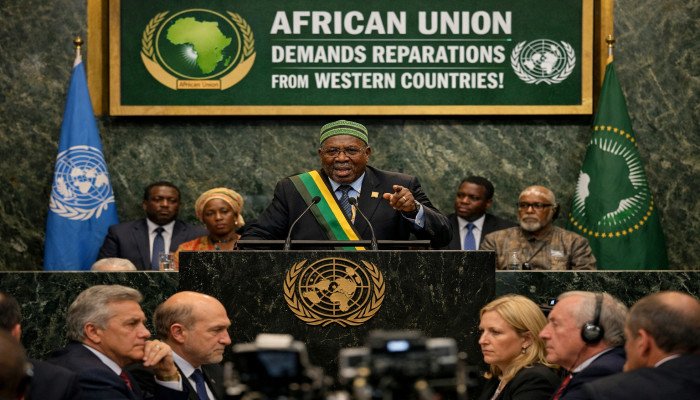
The Need for Comprehensive Reparations: A Call to African Union Leaders
Overview
As the African Union (AU) prepares for the “Year of Justice for Africans and People of African Descent Through Reparations” in 2025, one pressing issue looms large: the selective focus of reparations discussions. While advocating against historical injustices perpetrated by Western nations, there remains a significant silence concerning reparative justice regarding the exploitation by the Chinese Communist Party (CCP) and the historical slave trades conducted by Middle Eastern regimes.
A Critical Examination of Current Priorities
The Silence on China’s Exploitative Practices
In the last 70 years, the economic relationship between Africa and CCP-occupied China has deepened dramatically. In 2025 alone, bilateral trade reached an all-time high of $348 billion, marking a staggering 17.7% increase from 2024. Chinese exports surged, yet African exports only grew modestly, leading to an alarming trade deficit of $102 billion for Africa.
The Belt and Road Initiative (BRI) has further extended China’s influence through infrastructure projects across the continent, with African nations seeing $128.4 billion in construction contracts. However, this comes at a cost, with reports of “debt-trap diplomacy,” illegal mining, and environmental degradation.
Despite numerous accounts of exploitation—such as illegal gold mining in the Democratic Republic of the Congo and environmental damage in countries like Ghana and Zambia—no formal reparations claims have emerged against the CCP.
The Overlooked Historical Slave Trade
For over 1,400 years, Islamic regimes perpetrated the Trans-Saharan, Red Sea, and Indian Ocean slave trades, enslaving 6 to 18 million Africans. This historical atrocity remains largely unaddressed in AU discussions. A significant resolution passed in February 2026 brands slavery and colonialism as crimes against humanity but fails to extend its focus beyond European powers.
A Disturbing Trend of Selectivity
The AU’s 2025 reparations theme emphasizes the transatlantic slave trade while neglecting the broader context of historical injustices that also include the exploitation by Middle Eastern regimes and contemporary practices by the CCP. Ghana’s calls for reparations from European countries starkly contrast the absence of equivalent demands directed at China or the Middle East.
A Reflection on Historical Relations
Indigenous Partnerships: A Positive Contrast
In stark contrast to exploitative relationships, Indo-African relations spanning over 3,000 years exemplify peaceful trade and mutual respect. Indian merchants engaged in reciprocal exchanges without resorting to conquest or enslavement, a model of cooperation absent from the narratives surrounding European and Middle Eastern engagements with Africa.
A Call for Consistency and Inclusivity in Justice
The AU stands at a crossroads, with a golden opportunity to broaden its reparative framework. True reparatory justice must encompass a comprehensive examination of all exploitative practices affecting Africa’s people and resources. This includes acknowledging the CCP’s economic exploitation and the historical transgressions of Middle Eastern regimes.
Action Steps for the African Union
-
Broaden the Reparations Framework: Includes demands for accountability from China concerning trade imbalances and illegal activities.
-
Address Historical Slave Trades: Initiate discussions on reparations for the millions affected by the Middle Eastern slave economies.
- Promote Positive Interactions: Emphasize successful models of equitable partnerships to foster healthier international relations.
Conclusion
As the AU embarks on its reparative justice initiatives, the world watches closely. Leaders are urged to adopt a consistent and inclusive approach that addresses all forms of exploitation. The call for reparations must resonate not only with historical injustices by Western powers but also encompass the broader landscape of human suffering caused by various exploitative entities. Only through comprehensive accountability can true justice for African nations and people be achieved.
Disclaimer: The opinions expressed in this article represent the views of the author and not those of any affiliated organization. The information provided is meant to be informative and does not entail any responsibility for accuracy or completeness.
