

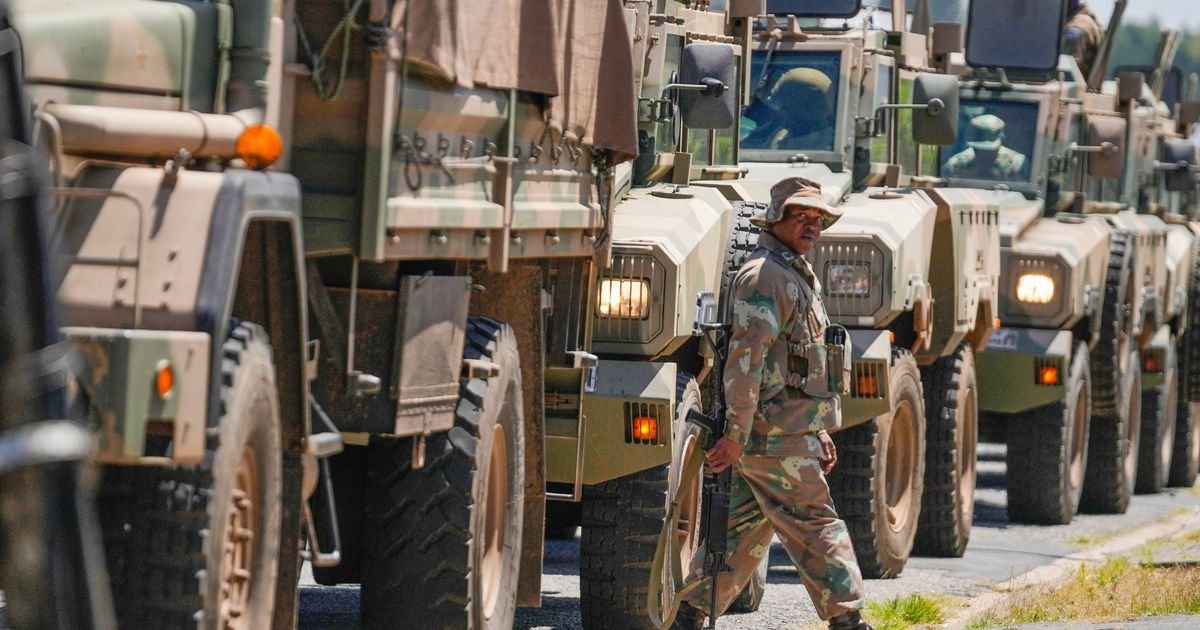
JOHANNESBURG (AP) — In an unprecedented decision for South Africa, a nation long regarded as Africa’s leading democracy, President Cyril Ramaphosa has announced the deployment of the military to combat escalating gang violence and illegal mining. This unconventional strategy comes in response to what Ramaphosa describes as a critical threat to both the nation’s security and its economic stability.
The first major military presence was observed on the streets of Johannesburg, South Africa’s largest city, on Wednesday. This deployment follows Ramaphosa’s commitment made last month to utilize the armed forces against organized crime, labeling it the “most immediate threat” facing the country’s democracy.
Planned operations will focus on five of South Africa’s nine provinces, and authorities indicated these deployments could continue for up to a year due to the severity of violent crime in these regions.
Critics argue that this military intervention reflects an acknowledgment of governmental failure in addressing crime effectively.
Violence in Tourist Hotspots
South Africa’s second-largest city, Cape Town, home to approximately 3.8 million residents, is a major tourist destination yet plagued by gang-related violence. The notorious Cape Flats neighborhoods are particularly affected, where notorious gangs such as the Americans, the Hard Livings, and the Terrible Josters are embroiled in long-standing turf wars over the lucrative illegal drug trade, extortion, and other criminal enterprises.
Bystanders, including innocent children, often find themselves caught in violent crossfires. Recent crime statistics reveal that three of the police precincts with the highest crime rates in the nation are located near Cape Town.
To mitigate gang violence, Ramaphosa revealed that army units would be deployed in the Western Cape province, which, alarming statistics show, accounts for around 90% of the country’s gang-related homicides. In addition to the Western Cape, troops will also be stationed in Gauteng (which includes Johannesburg) as well as the North West, Free State, and Eastern Cape provinces.
Addressing Illegal Mining Issues
In areas surrounding Johannesburg and broader Gauteng province, abandoned mine shafts contribute to rampant illegal gold mining activities. Authorities have identified criminal groups, colloquially known as ‘zama zamas’, who are armed and often violent. They exploit impoverished communities by recruiting informal miners to scavenge these shafts for valuable minerals.
These gangs are directly linked to heinous crimes, including a shocking incident in 2022 where around 80 illegal miners were implicated in the gang rape of eight women filming a music video at an abandoned mining site.
In a separate incident last year, a standoff between authorities and illegal miners resulted in 87 deaths amid police efforts to forcibly clear the mines. Analysts note that activities of these illegal miners extend beyond mining, leading to increased crime rates in their surrounding communities and forcing residents to flee for safety.
Estimates suggest that approximately 30,000 illegal miners are active in South Africa, utilizing around 6,000 abandoned mining sites, with the government stating that this illicit trade amounts to over $4 billion annually lost to organized crime syndicates. Disturbingly, accounts indicate that many involved in these gangs are migrants from countries like Lesotho, Zimbabwe, and Mozambique, exacerbating local tensions.
A Complex Legacy
Ramaphosa is acutely aware of the complex history surrounding military action in South Africa. Many citizens who witnessed the violent suppressions during apartheid are now cautious about military involvement in civil matters. Acknowledging this turbulent past, he emphasized the necessity of deploying the army in light of rising organized violent crime that poses a direct threat to public safety and state authority.
To alleviate concerns, Ramaphosa clarified that military operations would be executed under the command of police forces. There have been similar military deployments in recent years in response to civil disturbances, including troop mobilizations during the early months of the COVID-19 pandemic and in the aftermath of certain riots linked to the political unrest following former President Jacob Zuma’s imprisonment.
Experts on crime have voiced skepticism regarding the effectiveness of military involvement in law enforcement, arguing that the military is not designed to handle domestic crime. In defense of the deployment, South Africa’s police minister, Firoz Cachalia, stated that army personnel would support existing police operations aimed at stabilizing areas plagued by violence.
As this unprecedented military strategy unfolds, it raises crucial questions about the effectiveness of such measures in addressing the underlying issues of violence and crime within South Africa’s communities.
