

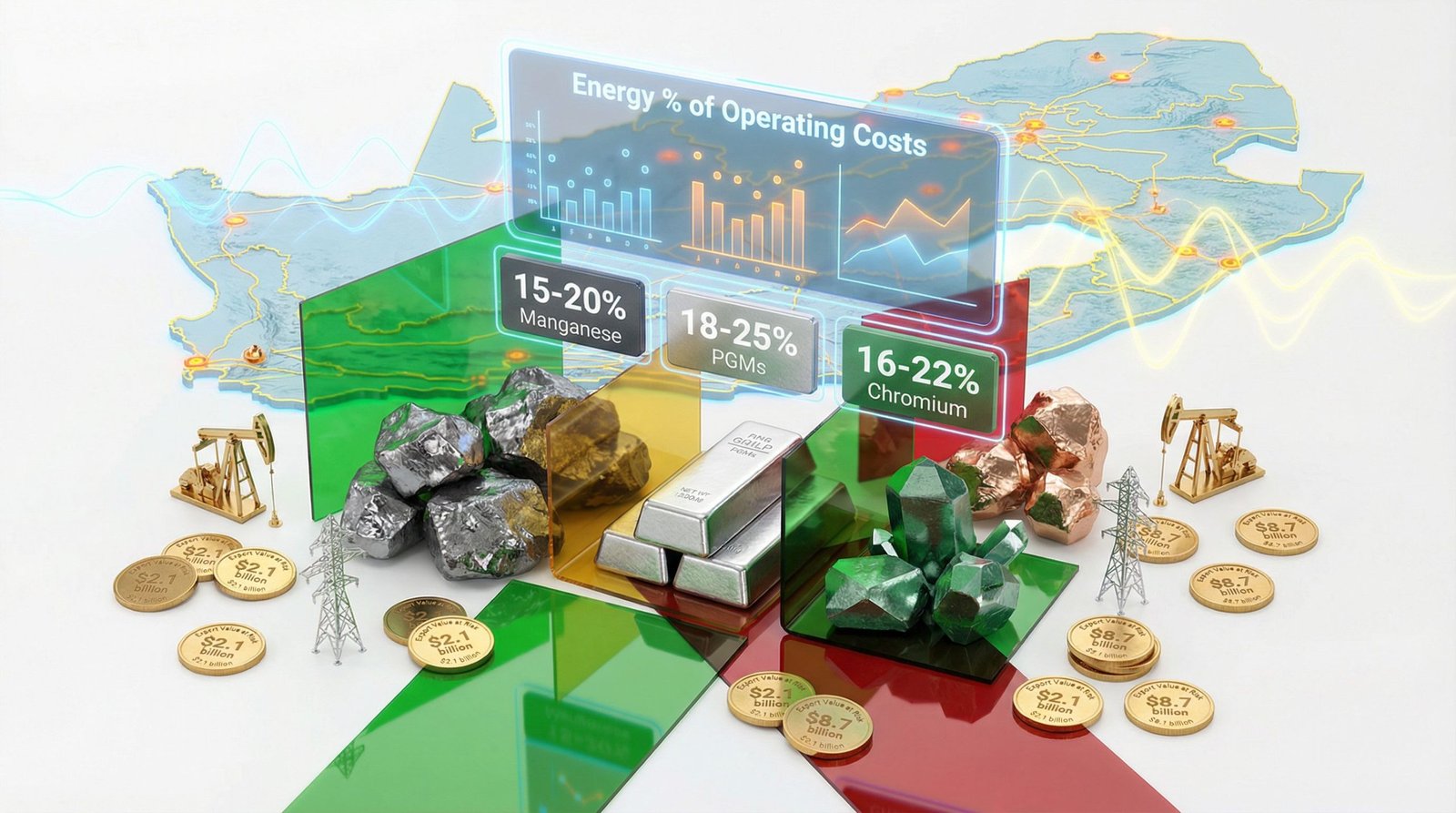
Global energy markets have recently entered a phase of intense volatility, affecting various sectors and extending beyond the traditional oil and gas realms. This interconnectedness of modern commodity supply chains has significant implications for national economies, particularly those reliant on resource extraction and export. For mineral-abundant countries, the interplay between rising energy costs and South Africa’s mining exports presents challenges that impact both immediate operations and long-term market strategies.
Integrating Energy Costs in Mineral Value Chains
The dynamics of rising energy costs and South Africa’s mining exports are complex, acting through several interconnected factors that exacerbate existing cost pressures. Unlike manufacturing sectors that can relocate or substitute inputs, mining operations operate under fixed geographical constraints and energy-intensive processes that are not easily altered.
Malcolm Curror, Chief Executive of United Manganese of Kalahari, highlights that energy influences virtually every aspect of mining—including heavy machinery operation, transportation via rail, road, and sea, as well as processing and beneficiation activities. This energy dependence renders mining operations particularly vulnerable to fluctuations in fuel prices throughout the production and export processes.
Key Energy Dependencies in Mining Operations:
- Diesel-powered heavy machinery for extraction operations
- Electricity-heavy processing and beneficiation facilities
- Transportation networks that move materials from mines to ports
- Port handling and export logistics
- Specialized storage and handling systems
The volatile energy market environment presents specific challenges for South African mineral exporters. For instance, surging oil prices—with increases up to 70% in certain areas—have already begun to affect agricultural production due to diesel shortages.
Analyzing Supply Chain Vulnerabilities
Mining operations exist within highly interconnected global supply chains, where disruptions can cascade across the system. When fuel prices soar, cost pressures can ripple through logistics networks, freight rates, and ultimately impact the competitiveness of final export pricing.
The current geopolitical climate has only exacerbated these challenges, with oil prices spiking amid uncertainty caused by instability in West Asia. Consequently, energy price volatility has far-reaching effects on commodities, particularly mineral producers. This has triggered shipping markets to adjust vessel routes and increased freight insurance premiums, raising transport costs across numerous trade routes.
Impact of Regional Energy Costs on Export Competitiveness
South Africa’s status as a leading global supplier of essential minerals exposes it to significant energy cost fluctuations. As the world’s largest manganese ore producer, it supplies crucial inputs for steel manufacturing in Asia and Europe.
Key Mineral Export Vulnerabilities:
| Commodity Sector | Global Market Position | Primary Export Destinations | Energy Intensity Level |
|---|---|---|---|
| Manganese Ore | World’s largest producer | Asian and European steel producers | High transport reliance |
| Platinum Group Metals | Dominant global supplier | Automotive and industrial markets | High processing energy demands |
| Chromium | Major global producer | Stainless steel manufacturers | Moderate energy intensity |
| Iron Ore | Regional supplier | Asia-Pacific steel mills | High rail transport expenses |
The manganese sector faces unique vulnerabilities due to its heavy reliance on rail transport to coastal ports, often governed by long-term contracts with fixed pricing structures. Rapid increases in energy costs can lock producers into agreements misaligned with current operational realities.
The Multiplicative Effect of Transportation and Logistics Costs
Increases in energy costs significantly impact South African mining exports throughout multiple transportation stages, creating compounded cost pressures that affect overall competitiveness. Rail transport, essential for moving the majority of mineral exports from inland mines to ports, represents a key cost component.
The interconnectedness of global shipping networks means that even minor adjustments can tighten available capacity and raise costs for exporters, independent of direct fuel expenses. Such constraints increase freight rates, particularly for bulk commodities requiring specialized vessels.
Manganese Operations Facing Market Pressures
As the world’s largest producer, South Africa’s manganese mining sector faces significant energy-related challenges due to its energy-intensive nature.
Factors contributing to the sector’s vulnerability include:
- High energy consumption during ore processing and beneficiation
- Rail transport reliance to transport products to coastal ports
- Competition from emerging producers benefiting from lower energy costs
- Long-term contracts that may not adequately reflect energy price changes
A significant portion of South Africa’s manganese production is directed toward steel producers in Asia and Europe, positioning the sector as particularly susceptible to global shipping disruptions and freight cost fluctuations.
Energy Challenges in the Platinum Group Metals Sector
While the platinum group metals (PGM) sector yields higher-value outputs, it grapples with substantial energy challenges stemming from complex extraction and processing operations. Deep-mine operations depend heavily on substantial electricity inputs, and the specialized refining processes required for market-ready PGMs necessitate consistent, high-quality energy supplies.
PGM Sector Energy Challenges Include:
- Deep mining that requires constant power
- Complex, multi-stage refining processes with high electricity needs
- Specialized transport for high-value products
- International pricing pressures despite premium positioning
The PGM sector’s sensitivity to energy costs is heightened by its role in emerging technologies, notably in automotive catalytic converters and industrial applications, where supply reliability is vital for fostering long-term client relationships.
Competitive Dynamics in Global Mineral Markets
The ongoing fluctuations in energy costs are reshaping competitive dynamics across global mineral markets, with South African producers increasingly facing threats from regions with more stable energy costs or alternative energy sources.
Key Competitive Considerations Include:
- Australian producers benefitting from renewable energy initiatives
- Chilean operations leveraging advantages from solar energy
- Canadian miners benefiting from hydroelectric power access
- Brazilian iron ore producers with established energy infrastructures
These competitive pressures are particularly pronounced for commodities where South African producers contend directly with other major players, as energy cost advantages can offer substantial pricing flexibility in international markets.
Demand Considerations Amidst Rising Energy Costs
Despite escalating energy cost pressures, various factors continue to drive demand for South African mineral exports. The global energy transition is fueling increased demand for platinum group metals, particularly in hydrogen fuel cell technologies, while infrastructure development in emerging markets sustains robust demand for steel-making inputs, such as manganese.
However, the relationship between energy costs and demand is becoming increasingly intricate, as downstream industries also struggle under rising energy pressures, potentially limiting their capacity to absorb higher input costs from mineral suppliers.
Strategic Adaptation and Operational Efficiency Measures
South African mining operations are adopting diverse strategies to counter energy-related cost challenges, although effectiveness varies markedly among different commodities and operational scales.
Energy Cost Mitigation Strategies Include:
- Installing renewable energy systems at mine locations to reduce dependence on grids
- Modernizing equipment aimed at enhancing fuel efficiency
- Utilizing process optimization technologies to lower overall energy consumption
- Implementing energy management systems to improve demand forecasting and load balancing
Major infrastructure changes typically require a 12-18 month timeline for significant energy efficiency measures. Additionally, innovations in electric mining transportation are aiding in reducing operational fuel costs, while some immediate measures can be rapidly deployed.
Integrating Technology for Efficiency Gains
Mining operations are increasingly leveraging advanced technologies to optimize energy consumption throughout their value chains. These innovations include automated systems for equipment operation, predictive maintenance programs to maximize efficiency, and integrated energy management platforms that respond to fluctuations in energy prices.
Moreover, sustainable mining innovations are becoming crucial for enhancing competitiveness in global markets. Nonetheless, the capital investments needed for comprehensive energy efficiency upgrades are often significant, necessitating a balance between immediate cost pressures and long-term efficiency gains.
Government Policies and Responses to Energy Challenges
The South African government recognizes the critical importance of preserving the competitiveness of the mineral export sector amidst challenges posed by rising energy costs and South African mining exports. Policy approaches have focused on immediate aid as well as long-term reforms to enhance energy security.
Key Government Initiatives Focus On:
- Creating special economic zones aimed at mineral beneficiation
- Encouraging independent power producer schemes to diversify energy sources
- Coordinating infrastructure investments between public and private sectors
- Establishing regional energy cooperation agreements to bolster supply security
These initiatives aim to tackle the challenges of energy cost unpredictability while addressing structural issues affecting the sector’s competitiveness.
Adapting the Regulatory Environment for Investment Growth
The regulatory framework governing South Africa’s mining sector is evolving in response to changing energy market dynamics. This includes policies designed to promote local beneficiation of mineral resources, which could mitigate some transport-related energy costs by adding value closer to extraction points.
However, the implementation and coordination of these policies across various government bodies will likely influence their effectiveness.
Strategic Shifts for Long-Term Sustainability
The current energy cost landscape is catalyzing strategic transformations within South Africa’s mining sector, potentially altering the structure and competitiveness of mineral exports for years to come.
Key Strategic Repositioning Trends Include:
- Increased emphasis on local beneficiation to capture added value from resources
- Establishing direct bilateral supply agreements to minimize risks from spot market volatility
- Driving technology-led efficiency improvements throughout the value chain
- Diversifying energy sources to lessen reliance on traditional fossil fuels
These strategic adjustments fundamentally change how mining operations handle energy and market positioning. For instance, green iron production initiatives showcase how innovative approaches can yield competitive advantages beyond the current phase of energy cost volatility.
Investment and Exploration Trends
Rising operational costs are influencing investment trajectories across the mining sector, particularly affecting exploration expenditures and the development of new projects. The economics of marginal projects are becoming increasingly difficult, while existing operations prioritize efficiency enhancements over expansion.
Investment Considerations Include:
- New project development facing higher thresholds due to energy cost unpredictability
- Reassessing exploration programs based on energy intensity demands
- Accelerating technology adoption for improved efficiency
- Forming international partnerships to access capital and expertise
Investor Sentiment in a Volatile Energy Landscape
The confluence of rising energy costs and South African mining exports has generated complex dynamics in investor sentiment. While some commodities benefit from supply limitations that sustain higher prices, energy volatility introduces uncertainties regarding profit margins and long-term viability.
International investors are increasingly evaluating mining operations based on their capacity to adapt to energy cost fluctuations, noting critical factors like renewable energy adoption, efficiency enhancements, and relative global positioning. Additionally, the benefits of mining decarbonization are becoming significant in investment evaluations.
Evolving Risk Assessment and Portfolio Strategies
Investment analysts are developing sophisticated frameworks for assessing mining sector vulnerability to energy cost fluctuations, factoring in elements like energy intensity ratios, geographic energy supply risks, and operational flexibility to respond to changing cost structures.
These evolving risk assessments influence capital allocation decisions and alter the relative appeal of various commodity sectors within South Africa’s mining industry.
Implications for Regional Economic Development
The challenges confronted by South Africa’s mining exports possess far-reaching implications for regional economic development, particularly within mining-dependent communities where the sector acts as a primary economic engine.
Energy cost challenges affect not only direct employment within mining operations but also extend to the extensive network of support services, transport providers, and regional businesses reliant on mining activity. The multiplier effects of competitiveness fluctuations in the mining sector can significantly influence local employment and economic growth.
Factors Impacting Regional Economic Health Include:
- Direct job opportunities within mining and processing facilities
- Indirect employment in logistics, maintenance, and associated services
- Regional business activity linked to mining sector demand
- Government revenues through mining-related taxation and royalties
The ongoing viability of these regional economic advantages largely hinges on the mining sector’s capacity to remain competitive amid rising energy costs. However, Africa’s energy poverty continues to present challenges for mining operations and broader economic growth across the continent.
