

The Intersection of Faith and Politics: Exploring Christian Nationalism
At the National Prayer Breakfast on February 5, 2026, Paula White-Cain, a senior adviser to the White House Office of Faith, hailed President Donald Trump as “the greatest champion of faith that we have ever had in the executive branch.” Following her remarks, Trump proclaimed, “I’ve done more for religion than any other president.” This incident raises a crucial question: Should political leaders advocate for religious causes? While some Americans support intertwining faith with governance, not all endorse the notion of a nation guided by specific religious laws.
Understanding Christian Nationalism
Those who affirm the relationship between faith and politics often align with the concept of Christian nationalism. This term varies in interpretation: for some, it signifies a blend of Christian belief and patriotism, while others assert that the United States should adhere strictly to Christian ethics and laws. This viewpoint can be influenced by a selective understanding of American history, often romanticizing the past as a ‘lost’ time when religion and governance were in harmony.
Historical Context: The Concept of Christendom
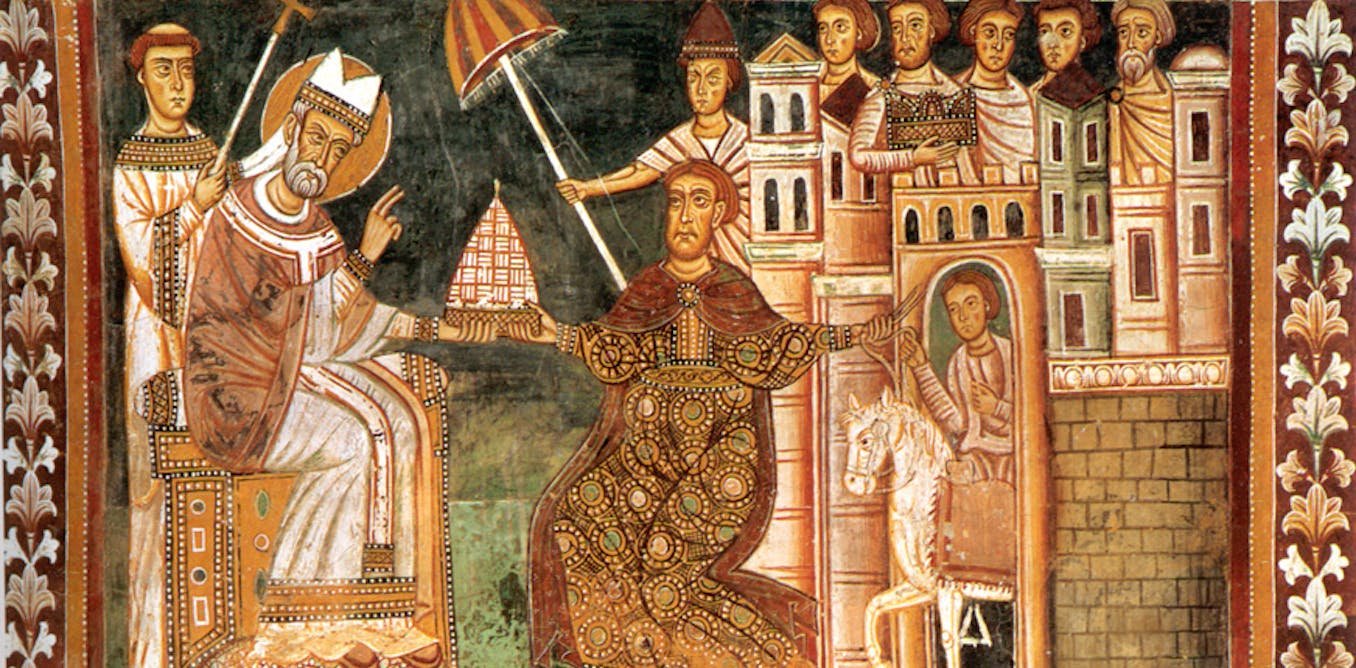
Many advocates of Christian nationalism evoke the term “Christendom,” referring to a period lasting approximately 1,000 years from the fall of Rome around 500 C.E. to the onset of the modern era around 1500. This era was marked by a close relationship between Christianity and governance, with popes exerting authority over European monarchs and religious institutions shaping societal values.
Wikimedia Commons
In contemporary political discourse, some factions regard this period as a golden age of Christian cohesion when faith and state were aligned. Notably, various groups, such as the Catholic-inspired The Josias, promote the idea of integrating faith into public life while resisting liberalism and modernism. Additionally, certain conservative Protestant perspectives advocate for a “new Christendom,” emphasizing a societal framework rooted in Christian values.
The Vision of Modern Christendom
Figures like Pastor Doug Wilson have articulated visions of “mere Christendom,” where nations acknowledge the lordship of Jesus Christ and the truths of the Apostles’ Creed without reverting to theocracy. In his writings, Wilson calls for a civic recognition of Christian principles to form a cohesive society. Similarly, minister Andrew Isker’s book, “The Boniface Option,” endorses the idea of establishing a contemporary Christian societal structure.
Challenges in the Pursuit of Christian Governance
However, historical perspectives challenge the viability of these modern interpretations. The medieval landscape was diverse, encompassing Jewish and Muslim communities and a lack of consensus among Christians regarding the relationship between earthly rulers and spiritual authority. Such complexities are often overlooked in contemporary discussions about the ideal governance structure.
Critical Perspectives from History
When examining the connections between faith and political authority, thinkers like Eusebius of Caesarea and Saint Augustine provide insightful yet contrasting views. Eusebius celebrated the reign of Emperor Constantine, who unified Christianity with his imperial rule. He suggested that God intended for the secular and spiritual realms to be intertwined, predicting a flourishing of Christian doctrine under imperial governance.

J. Paul Getty Museum/Wikimedia Commons
On the other hand, Augustine warned against an over-reliance on earthly rulers to enact God’s will. He advocated for “just wars” while maintaining skepticism toward the idea that any kingdom could fully embody the divine kingdom. His assertion that true loyalty lies in the eternal “City of God” rather than the transient “City of Man” emphasizes the complexity of blending faith with politics.
The Modern Implications of Historical Thought
The dichotomy between the notions of Christendom and the skepticism expressed by Augustine reflects the ongoing debate surrounding faith’s role in governance. This intricate relationship is multifaceted and speaks to broader questions of identity and power, requiring a nuanced understanding of both historical and contemporary contexts.
In conclusion, discussions about Christian nationalism and its implications on governance today are inherently complex. Embracing a singular narrative oversimplifies the rich diversity of thought and experience that has shaped the historical and contemporary relationship between faith and political identity. Rather than viewing it solely through the lens of a unified Christian agenda, it’s essential to recognize the intricate web of beliefs that have shaped societies throughout history.


