

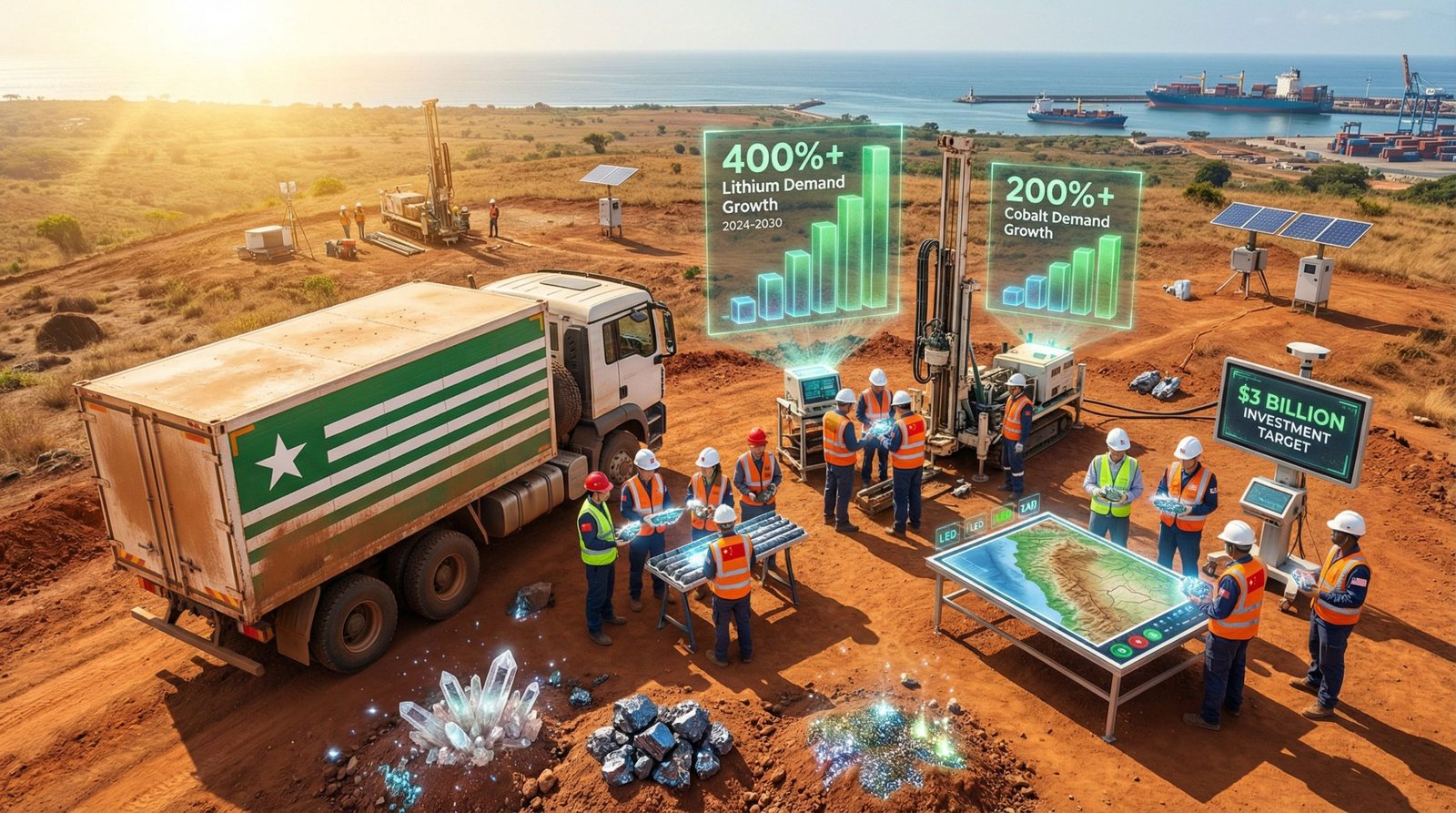
Transforming West Africa’s Mineral Landscape: A New Era of Exploration and Assessment
West Africa’s mineral landscape has seen remarkable changes due to international collaborations, technological advancements, and strategic resource mapping initiatives. Over the years, the region’s geological wealth has attracted various exploration methodologies, from traditional ground surveys to modern satellite-based analysis. This article delves into how these technological shifts have reshaped national resource portfolios, highlighting the recent discovery of mineral deposits in Liberia funded by China as a key example.
How Advanced Survey Technologies Revolutionised West African Resource Assessment
Bridging the Five-Decade Knowledge Gap in Geological Mapping
Liberia’s history of mineral assessment showcases a critical knowledge gap extending over half a century. The last comprehensive geological survey, undertaken in 1973 with U.S. technical assistance during the Cold War, marks a 52-year hiatus in major geological surveys—one of the longest gaps in contemporary African mineral exploration.
The 1973 survey relied on analog mapping techniques, where field geologists performed physical sampling and basic geochemical analysis, often limited by accessibility to more remote regions. Additionally, Liberia’s civil unrest from 1989 to 2003 halted systematic exploration efforts, disrupting institutional capacity and crucial geological records.
Embracing Modern Remote Sensing and Digital Integration Techniques
The recent China-funded mineral deposits survey in Liberia utilised advanced remote sensing technologies inconceivable during the 1970s. Through high-resolution satellite imagery, hyperspectral analysis, and digital geographic information systems, researchers achieved extensive territorial coverage impossible solely through on-ground methods. These technological advancements reflect broader trends in the evolution of the global mining industry.
Key advancements include:
- Satellite Imagery Resolution: Sub-meter precision compared to earlier aerial photography limitations.
- Geochemical Sampling Density: Transition from opportunistic collection to systematic grid sampling.
- Data Integration Capabilities: Real-time digital databases as opposed to paper-based archives.
- Mineral Identification Accuracy: Employing spectral analysis versus visual assessment.
The survey identified 22 distinct mineral categories across Liberia, including lithium, cobalt, and uranium, marking it as one of the most comprehensive geological inventories produced for any West African country in recent decades.
International Partnership Models in African Geological Surveys
The China-funded mineral deposits survey in Liberia is part of the broader Belt and Road Initiative, which encompasses geological assessment programs across sub-Saharan Africa. Similar partnerships have emerged in Ghana, Sierra Leone, and Guinea, emphasizing technology transfer, capacity building, and collaborative data sharing.
China’s approach focuses on long-term bilateral cooperation as opposed to short-term exploration, ensuring that survey results are accessible to Liberian government institutions while maintaining Chinese geological organizations’ expertise. This method contrasts sharply with traditional Western mining company models that restrict assessments to specific concession areas.
Critical Mineral Portfolio Positioning in Global Supply Chain Networks
Analyzing Battery Metal Market Dynamics and Demand Projections
Global lithium demand is poised for exponential growth, largely owing to electric vehicle adoption and battery storage systems. The International Energy Agency projects a leap from approximately 0.5 million tonnes of lithium in 2023 to over 2.0 million tonnes by 2030, corresponding to a 300% increase.
The breakdown of projected lithium consumption includes:
- Electric Vehicles: Approximately 70% of total projected demand increase.
- Utility-Scale Storage: An additional 20%.
- Consumer Electronics: Stable consumption patterns compared to energy transition sectors.
A detailed Global Battery Metal Market Position Analysis indicates strong growth trajectories in other metals as well:
| Mineral | 2023 Global Demand | 2030 Projected Demand | Growth Rate | Current Market Leaders |
|---|---|---|---|---|
| Lithium | 0.5M tonnes | 2.0M+ tonnes | 300%+ | Australia (50%), Chile (25%) |
| Cobalt | 140K tonnes | 380K+ tonnes | 170%+ | DRC (70%), Russia (8%) |
| Nickel | 3.0M tonnes | 4.5M+ tonnes | 150%+ | Indonesia (35%), Philippines (15%) |
| Neodymium | 35K tonnes | 55K+ tonnes | 160%+ | China (85%), Myanmar (8%) |
Liberia’s recent mineral discoveries position the nation as a potential alternative supply source amid global energy transitions, although significant investment in processing infrastructure will be paramount for market entry.
Understanding Rare Earth Elements and Their Strategic Implications
Neodymium findings from Liberia’s survey hold geopolitical importance given China’s dominance in rare earth element processing, controlling approximately 85% of global rare earth mining and 95% of separation and refining capabilities. Wind energy targets indicate neodymium demand could exceed 55,000+ tonnes annually by 2030.
Countries worldwide are increasingly focused on supply chain diversification due to concerns surrounding rare earth concentrations. Both the U.S. Strategy for Domestic Extraction and the EU’s Critical Raw Materials Resilience Strategy underscore these objectives.
Processing Infrastructure Requirements and Investment Realities
The leap from discovering mineral deposits to establishing commercial production is substantial. Processing lithium into battery-grade compounds involves considerable investments, typically ranging from $500 million to $2 billion+, depending on capacity and technology.
Moreover, Liberia’s current industrial infrastructure lacks established processing capabilities, with its electrical generation capacity ranked among the lowest on the continent. A robust Critical Infrastructure Development Prerequisites list indicates urgent needs across several sectors:
- Processing Facilities: Specialized plants for lithium and cobalt.
- Power Generation: Adequate energy supply of 200-400 MW specified for mineral processing.
- Transportation Networks: Efficient bulk mineral handling and export mechanisms.
- Water Resources: Adequate water supply for processing operations.
- Technical Expertise: A workforce skilled in hydrometallurgical processes.
Investment Framework Development and Legal Infrastructure Evolution
Liberia’s existing Mining and Minerals Law (2000) requires extensive revisions to engage with contemporary technologies and investment standards demonstrated in the China-funded survey. The Ministry of Mines and Energy is currently working on updates to streamline regulatory frameworks crucial for attracting foreign investments.
Key Regulatory Modernisation Requirements include:
- Comprehensive environmental impact assessments.
- Community benefit-sharing mechanisms reflecting global best practices.
- Updated foreign investment screening procedures concerning strategic minerals.
- Technology transfer obligations.
- Revenue transparency aligning with the Extractive Industries Transparency Initiative standards.
Comparing West African Regional Mining Policies
Regulatory environments across ECOWAS member states show significant variation. For instance, Ghana emphasizes local content and joint ventures, while Sierra Leone focuses on concession agreements with equity stakes. Below is a comparative overview:
| Country | Primary Legislation | Royalty Structure | Local Content Requirements | Environmental Standards |
|---|---|---|---|---|
| Ghana | Minerals & Mining Act (2006) | 3-12% sliding scale | 90% local procurement | EPA licensing mandatory |
| Sierra Leone | Mines & Minerals Act (2009) | 4-6% base royalty | Skills development levy | Environmental bond required |
| Guinea | Mining Code (2011) | 0.5-5% by commodity | Local employment quotas | Impact assessment required |
| Liberia | Mining Law (2000) | Under revision | Framework development | Capacity building needed |
Attracting Foreign Direct Investment and Structuring Partnerships
The $3 billion investment target reflects aggregate potential across various sectors, encompassing exploration, infrastructure, and processing facilities. Below is an analysis of expected investment categories:
- Exploration and feasibility: $200-500 million (2025-2028)
- Mining infrastructure development: $1.0-1.5 billion (2028-2032)
- Processing facility construction: $800 million-1.2 billion (2030-2034)
- Transportation and logistics: $300-600 million (2029-2033)
- Supporting infrastructure: $200-400 million (ongoing)
International mining players spanning established African operators to Chinese state-owned enterprises are examining opportunities in Liberia, each with unique risk profiles and operational expertise.
Infrastructure Development Prerequisites for Economic Transformation
Transportation Networks and Export Capacity Constraints
Current operations at the Port of Monrovia indicate a capacity of approximately 5 million tonnes of annual cargo. Bulking mineral exports from newly discovered deposits necessitate significant port infrastructure improvements.
Additionally, Liberia’s railway system lacks the required connectivity to transport minerals effectively. New railway investments could total $2-4 billion, dependent on route specifications.
Energy Infrastructure Expansion for Industrial Operations
With Liberia’s 126 megawatts of current electrical capacity, significant upgrades are essential to provide the required 200-400 megawatts for processing operations.
Power Generation Requirements by processing type include:
- Lithium processing: 50-100 MW per 50,000 tonnes annual capacity.
- Cobalt refining: 80-150 MW.
- Rare earth separation: 100-200 MW for integrated facilities.
- General mining operations: 30-60 MW.
Integrating renewable energy projects offers potential, though consistent power is necessary to meet industrial demands.
Economic Diversification Strategy and Export Revenue Enhancement
Liberia’s economic structure currently shows heavy reliance on traditional commodities, with iron ore and rubber comprising a significant portion of export revenues. Transitioning to a more diverse export portfolio is vital for sustainable growth.
With successful development of newly discovered mineral portfolios, it’s projected that minerals could contribute 25-30% of national export revenues over the next 8-12 years—a transformation reliant on coordinated investments across various sectors.
Employment Generation and Technical Skill Development Needs
Large-scale mineral extraction could provide direct employment for 15,000-25,000 individuals while creating an additional 30,000-50,000 indirect job opportunities through supplementary industries.
Targeted technical training will be crucial, requiring expansions in local educational programs encompassing:
- Mining engineering.
- Metallurgical processing.
- Environmental management.
- Equipment operation and maintenance.
- Quality control expertise.
Risk Assessment and Resource Management Governance Frameworks
Environmental Impact Management and Sustainability Protocols
Robust environmental management is vital for large-scale operations within Liberia’s unique ecosystems. Experts advocate for comprehensive strategies addressing water resources and biodiversity conservation to avoid the pitfalls experienced in regions like the Democratic Republic of Congo.
Mitigating the Resource Curse with Transparent Revenue Management
Countries rich in resources often struggle with effective revenue management. Learning from successful models, such as Norway’s sovereign wealth fund, Liberia can set the stage for transparent governance frameworks.
Requirements for Transparent Governance include:
- Revenue disclosure mandates.
- Establishing a sovereign wealth fund.
- Community benefit-sharing policies.
- Anti-corruption practices.
- Parliamentary oversight of mining contracts.
Geopolitical Dynamics and International Partnerships
The dynamics surrounding Liberia’s resources define its geopolitical interactions, especially as it balances ties with traditional Western partners and the burgeoning presence of Chinese investment. The European Union’s critical raw materials initiative showcases alternate paths for investment in Liberia’s mineral assets as nations strive for supply chain diversification.
In conclusion, Liberia stands at a pivotal intersection of opportunity and challenge. With inclusive policies, partnership structures, and a clear focus on environmental sustainability, the nation can reshape its economic landscape.
This analysis is for informational purposes. Investors should conduct thorough due diligence and consult qualified advisors before making investment decisions, as projected timelines and forecasts carry significant uncertainty.
For real-time insights on pivotal discoveries, check out Discovery IQ. Get ahead of the market with our 14-day free trial, allowing you to seize opportunities before they materialise.
