

Addressing Logistics Bottlenecks: A Call to Action for Kenya’s Manufacturing Sector
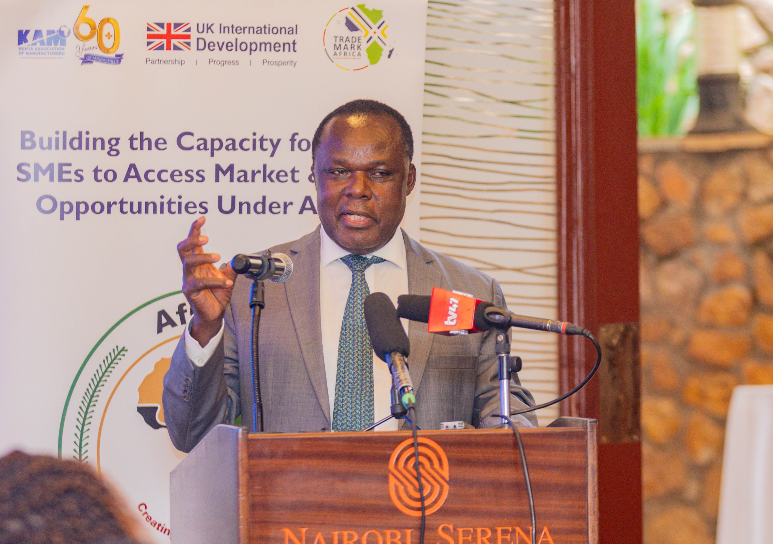
Industry PS Juma Mukhwana speaks during the launch of the Logistics Study Report by Kenya Association of Manufacturers /HANDOUT
Kenya’s manufacturing sector is urgently calling for improvements in logistics infrastructure to enhance its competitive edge and fully exploit opportunities presented by the African Continental Free Trade Area (AfCFTA). This appeal came during the unveiling of the Logistics Study Report by the Kenya Association of Manufacturers (KAM).
Logistics Costs: An Ongoing Challenge
The findings from the Logistics Study Report reveal persistent challenges in the logistics landscape. Costs associated with transporting goods within Africa remain notably high and unpredictable. For instance, shipping a 20-foot container along the Nairobi–Lusaka corridor incurs costs between $3,500 and $7,000, with transit periods stretching from eight to 30 days due to border delays and operational hiccups.
The Impact on Small and Medium-Sized Enterprises
Although AfCFTA has facilitated access to a market encompassing 54 African nations, many Kenyan manufacturers, especially small and medium-sized enterprises (SMEs), face significant hurdles in capitalizing on these opportunities. Key issues include:
- Border inefficiencies
- Poor infrastructure
- High freight charges
- Limited cargo consolidation systems
Industry Principal Juma Mukhwana emphasized that the government is actively addressing these logistical barriers through various policy initiatives and investments in infrastructure. “The essential role of government is to cultivate a supportive environment for business growth. Kenya must seize this moment,” he stated.
Path to Competitiveness
Mukhwana stressed the need for Kenya to move beyond merely exporting raw materials. “We must enhance local and regional value creation, which necessitates infrastructure investment, support for SMEs, and improved regional integration,” he noted.
Projects such as the Standard Gauge Railway and County Aggregation and Industrial Parks are pivotal in fostering efficiency and connecting producers to broader markets.
Tobias Alando, KAM’s chief executive, stated that the report reveals logistics as the primary barrier to competitiveness, overshadowing market access. “While markets are expanding, the logistics systems connecting us are lagging behind,” he remarked. “In many cases, the costs associated with logistics surpass the advantages of lower tariffs, leading to non-competitive pricing by the time goods reach their destinations.”
The Real Cost of Logistics for SMEs
For SMEs, the challenges are exacerbated. Harriet Ngo’k, founder of Harriet Botanicals, shared her experience regarding the unpredictability of shipping costs, which influence trade decisions directly. “Transporting goods valued at Sh30,000 incurs costs of Sh14,000 to arrive in Rwanda and Sh17,000 for Nigeria. Such high and volatile rates dictate our trade locations,” she explained.
Moreover, delays in key corridors disproportionately impact businesses dealing with perishable products. “My items have a shelf life of three to six months, yet reaching nearby markets like Uganda can take seven to ten days. By the time they arrive, a portion of their shelf life is already lost,” declared Ngo’k, who also chairs KAM’s SME Hub.
Recommendations for Improvement
Lilian Mwai, Country Director for TradeMark Africa, advocated for the study’s insights as a roadmap for necessary reforms. “This report doesn’t simply highlight problems; it identifies core bottlenecks—from high clearance costs to infrastructure delays—that need addressing to unlock intra-African trade,” she observed.
The report proposes key strategies for overcoming logistical challenges, including:
- Enhanced coordination among border agencies
- Investment in advanced infrastructure
- Development of cargo aggregation systems to aid SMEs in reducing costs
Industry leaders warn that without these reforms, the transformative benefits of AfCFTA may remain unattainable for numerous Kenyan businesses.
