

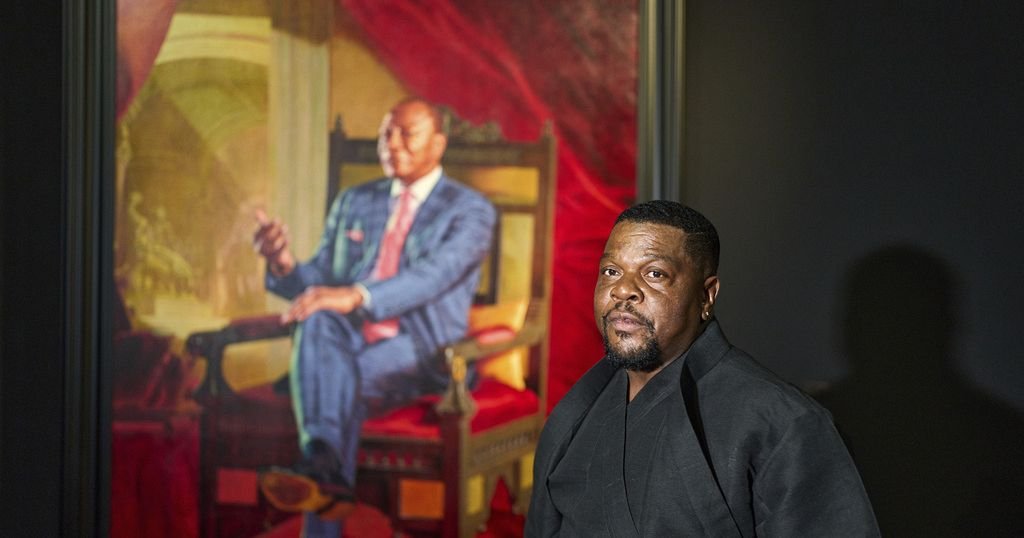
Kehinde Wiley’s "A Maze of Power": A Reflection on African Leadership
American artist Kehinde Wiley recently unveiled an impressive collection of large-format portraits featuring African leaders at the Mohammed VI Museum of Modern and Contemporary Art in Rabat, Morocco. This exhibition, titled "A Maze of Power," builds on Wiley’s acclaimed 2018 portrait of Barack Obama, which featured the former U.S. President surrounded by vibrant flora.
Celebrating African Leadership Through Art
The "A Maze of Power" exhibition made its debut in Paris and Dakar, Senegal before its arrival in Morocco. Wiley’s distinctive approach draws inspiration from classical easel painting techniques, portraying African leaders in a manner traditionally associated with European royalty and aristocracy.
“What I wanted to do was to draw ideas in, to be able to look at the depiction of power, both beautifully and problematically,” Wiley explained, emphasizing the layers of meaning within his artwork.
Featured Portraits and Symbolism
The exhibition showcases a variety of leaders, each depicted in unique and meaningful contexts:
- Sahle-Work Zewde, former president of Ethiopia, is illustrated standing gracefully before a window, with her nation’s capital sprawling behind her, gently holding a dangling flower.
- Hery Rajaonarimampianina, the former president of Madagascar, is confidently portrayed riding a horse, symbolizing strength and authority.
- Alassane Ouattara, President of Ivory Coast, is depicted with a sword in hand, furrowed brow indicating the weight of leadership.
Wiley stated to The Associated Press that his intention was to explore the presidency as a symbol of power.
A New Hub for African Art
The exhibition arrives at a significant time for Moroccan art, as the Mohammed VI Museum aims to become a central hub for African culture, ahead of the opening of the forthcoming Museum of the African Continent in Rabat next year.
Portraits with Purpose
The inspiration for these portraits came from Wiley’s growing connections with African leaders, largely influenced by the success of his Obama portrait. He engages his subjects by sharing a book of classical paintings for inspiration, creating an authentic representation of power through carefully planned settings—both real and abstract.
Wiley emphasized that while some of the depicted leaders may have controversial political legacies, the focus of his series is not their individual choices. Instead, he aims to provide a broader perspective on the phenomenon of political portraits.
Political Context and Artistic Revelation
The exhibited leaders include those mired in corruption scandals and authoritarian practices, such as Paul Kagame of Rwanda and Felix Tshisekedi of Congo, who are currently involved in military conflicts in eastern Congo. Wiley noted the dual role of art, stating that while some works highlight the impact of political decisions, his project takes a more elevated view, examining the nature of political portraiture itself.
In sum, Wiley’s "A Maze of Power" serves as an engaging exploration of African leadership, balancing beauty and critique, while illustrating the complexities of power and representation in today’s world.
For more on Wiley’s groundbreaking work and the importance of African art, visit The Culture Trip.
