

Understanding Türkiye’s Curad-1 Operation in East African Energy Geopolitics
The Significance of Türkiye’s Curad-1 Operation
Türkiye’s Curad-1 deepwater drilling project off the coast of Somalia marks a pivotal moment in the country’s global energy expansion efforts. This ultra-deepwater initiative demonstrates how such operations are deeply intertwined with geopolitical strategizing, requiring a nuanced understanding of technical capacity, resource availability, and regional dynamics.
Strategic Maritime Positioning in the Horn of Africa
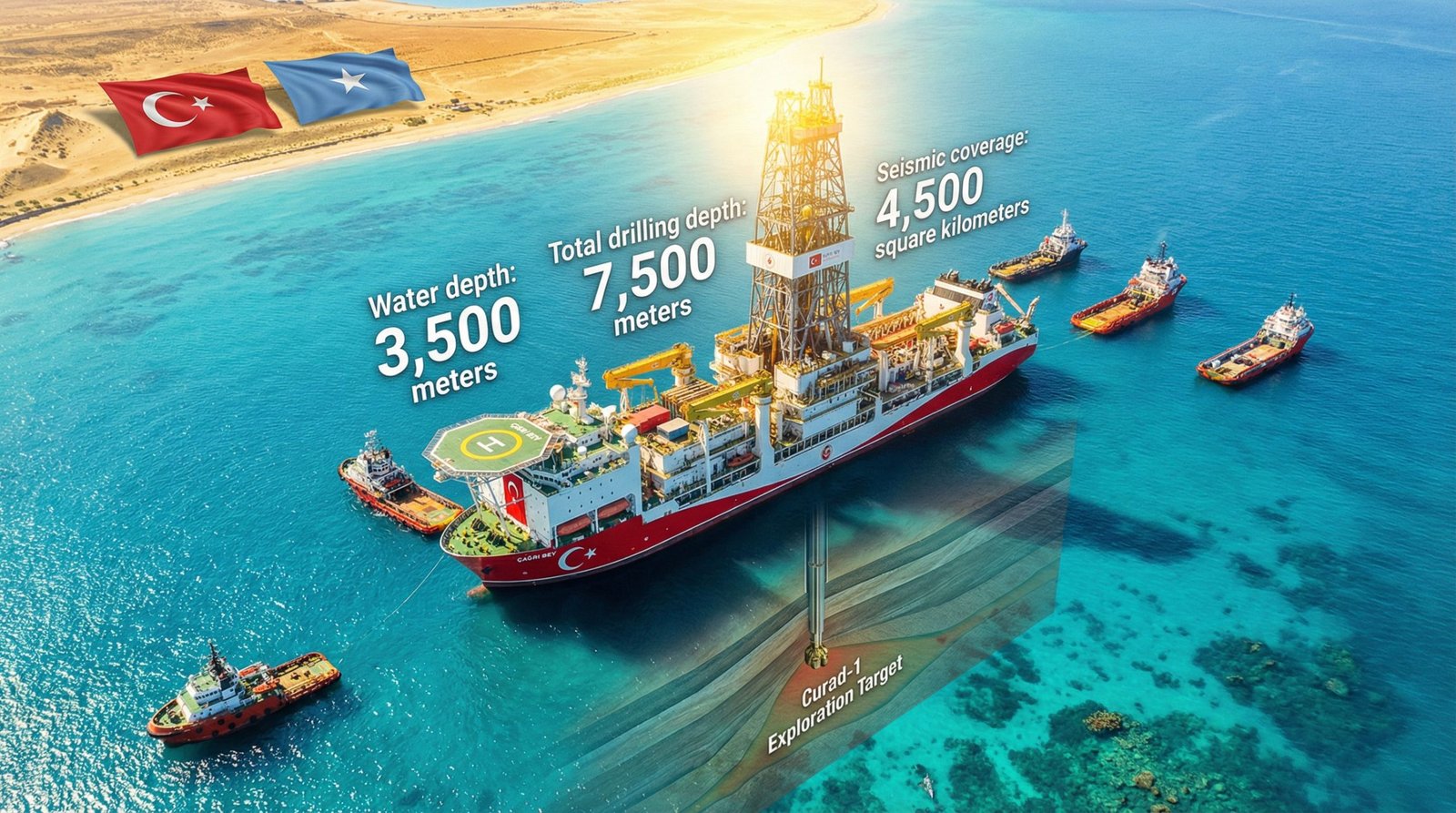
The Çağrı Bey drillship has entered Somali waters, operating at a depth of 3,500 meters approximately 370 kilometers from Mogadishu. This represents Türkiye’s first significant presence in the Indian Ocean basin, moving beyond its traditional Eastern Mediterranean and Black Sea focus.
Somalia’s Exclusive Economic Zone (EEZ), covering about 833,000 square kilometers, is among Africa’s largest maritime zones. The Curad-1 drilling location is a challenging ultra-deepwater setting that mandates specialized equipment capable of operating under extreme environmental conditions, all while lacking traditional anchoring infrastructure.
Complex regional dynamics include rival interests from Ethiopia, which is landlocked and requires offshore access, and ongoing disputes between Kenya and Somalia regarding maritime boundaries, complicating the operational landscape for any international player.
Turkey-Somalia Energy Partnership Framework
Türkiye’s engagement in Somalia’s offshore sector is backed by various bilateral cooperation frameworks; however, detailed energy agreements remain largely undisclosed. Türkiye has invested in crucial infrastructure in Somalia, including:
- Camp TURKSOM, which provides regional security.
- Mogadishu port operations that ensure logistic support.
- An expanding diplomatic mission in the broader Horn of Africa.
The Curad-1 operation seems to be a coordinated effort between Turkish state energy companies and Somali maritime authorities, although specific terms for revenues and regulatory frameworks are not publicly available. A decade of technical advancements has equipped Türkiye for such an operation, with the Oruç Reis seismic vessel acquiring extensive data for accurate geological assessments.
Implications for Regional Power Balances
East Africa’s offshore regions interest many international firms, including Chinese entities in Kenya and Tanzania and European companies focused on Mozambique’s gas reserves. Türkiye’s entry complicates these competitive dynamics as the Indian Ocean gains heightened security focus from global powers.
As China’s Belt and Road Initiative develops East African ports, Western players retain established positions in existing hydrocarbon zones. Turkish capabilities contribute to a growing technical sovereignty, reducing reliance on international service providers.
Transforming Frontier Basin Economics through Ultra-Deepwater Operations
Technical Specifications and Challenges
Curad-1’s operation falls squarely into ultra-deepwater classifications as defined by the International Association of Oil & Gas Producers (IOGP), with water depths exceeding 3,000 meters requiring specialized systems. Operating at 3,500 meters presents significant challenges, including:
- Pressure management systems to manage extreme pressures.
- Engineering tailored for a 3,500-meter riser system.
- Blowout preventer (BOP) stacks adequate for ultra-deepwater conditions.
- Strategic weather planning for operational viability.
Investment and Risk Assessment in Undeveloped Regions
Investing in ultra-deepwater exploration demands significantly higher capital, often ranging between $150-250 million per well. Projects like Curad-1 come with inherent geological, commercial, and technical risks, such as:
- Geological uncertainty, limited data, and complex structures.
- Commercial challenges including vague regulations and market access.
- Operational complexities from deep-water logistics.
The Attraction of Somalia’s Offshore Blocks
Geological Potential
Somalia benefits geologically from characteristics akin to successful East African petroleum systems, notwithstanding a historical lack of exploratory data. The Oruç Reis vessel has provided key seismic data to better outline potential drilling targets.
Key geological indicators include:
- Source rock potential from organic-rich formations.
- Reservoir formations and structural similarities to nearby successful regions.
- Seal integrity capabilities through mudstone and evaporite sequences.
Proximity to Established Hydrocarbon Regions
Somalia’s offshore blocks are strategically located near established hydrocarbon reserves in Tanzania and Kenya, demonstrating favorable geological conditions for potential discoveries.
Navigating Somalia’s Regulatory Environment
Somalia’s offshore regulatory framework is still evolving, presenting both risks and opportunities for international operators. Key regulatory factors include:
- Licensing authority and its coordination with the federal and regional governments.
- Fiscal frameworks must be established for revenue sharing and local content requirements.
- International arbitration mechanisms are essential for dispute resolution.
Türkiye’s Offshore Fleet and Global competitiveness
Fleet Overview
Türkiye’s offshore fleet development, particularly the Çağrı Bey, showcases its capabilities to participate competitively in the deepwater market. While global capacity for ultra-deepwater drilling entwines fewer than 80 active units, Türkiye’s entry into this highly competitive sector reflects a growing operational independence.
Fleet Specifications Include:
- Dynamic positioning systems for anchoring.
- Advanced BOP systems.
- Extensive depth capacities exceeding 7,500 meters.
Strategic Deployments
By maximizing local resource development while building operational independence, Türkiye aims to integrate more deeply into the international energy market. The deployment to Somalia signifies a broader strategic motif aligning with Türkiye’s energy diversification goals while responding effectively to current geopolitical dynamics.
Impact on East African Energy Security
Supply Chain Development
The Curad-1 operation could set a foundation for Indian Ocean deepwater logistics, which will be crucial for subsequent explorations and projects. Developing robust infrastructure, including:
- Port facility upgrades to support deepwater operations.
- Improved airport capacities for international collaboration.
- Enhanced communication networks for operational efficiency.
Investment Requirements and Infrastructure
Successful commercial discoveries will necessitate substantial upfront investment in infrastructure. This may require between $5-15 billion in investments, depending on discovery sizes, advocating for collaborative development strategies to optimize costs.
Geopolitical Competition in the Indian Ocean
Türkiye’s deepwater initiatives will feed into broader geopolitical currents in the Indian Ocean, where competing interests are prominent from China, the U.S., and others. This competition may influence the overall nature of energy access and security in the region.
Path Forward for Curad-1: Potential Outcomes and Steps
Success Scenarios
The results of the Curad-1 well are pivotal, triggering appraisal and development phases that could transform Somalia into a significant hydrocarbon player. Positive outcomes could redefine global energy markets while potentially impacting pricing dynamics.
Expansion of Exploration Programs
Successful results from Curad-1 could facilitate a broader exploration program throughout Somalia’s expansive EEZ. Subsequent initiatives may not only bolster the sector but also elevate Somalia’s profile in the global energy arena.
Conclusion
Türkiye’s Curad-1 drilling initiative represents a bold step into the evolving realm of East African energy geopolitics. The operation’s significance transcends mere exploration; it embodies the intersection of geopolitics, economics, and regional power dynamics that shape the future of energy in the area. The implications for Somalia could be vast, fundamentally reshaping not only its economic landscape but also its positioning in the broader global energy market.
