

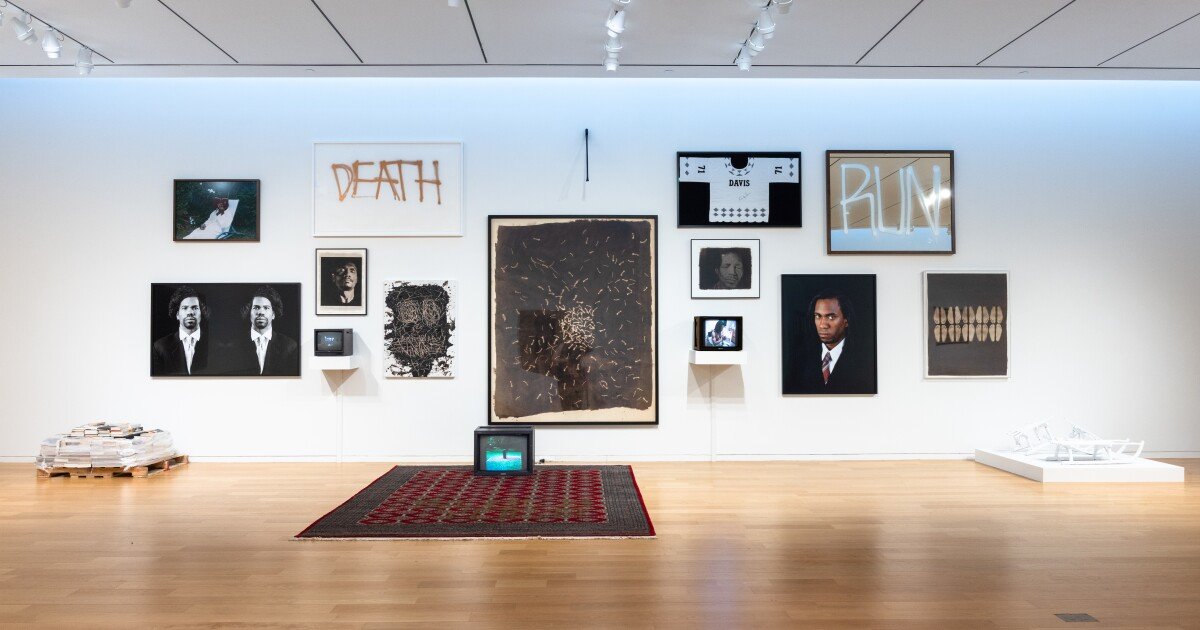
In a captivating new exhibition titled “A Poem for Deep Thinkers,” artist Rashid Johnson explores themes of identity, vulnerability, and connection over nearly three decades of creative work. Currently hosted at the Modern Art Museum of Fort Worth, the exhibition invites visitors to step closer to the art, fostering a unique interaction between the viewer and the pieces on display.
One highlight of the exhibition is a striking painting called Anxious Men. This deep, earthy red artwork is characterized by dense, looping strokes that evoke a sense of urgency and introspection. Johnson encourages visitors to engage with this piece by stepping up onto a low platform built in front of it, allowing them to become part of the art experience.
Exploring Identity Through Art
Rashid Johnson, a Chicago native born in 1977 and now residing in New York, rose to prominence in the early 2000s. He is celebrated for his innovative approach to the exploration of identity, particularly through the lens of African diasporic history and culture. His work resonates with audiences for its multifaceted exploration of personal and collective experiences.
Across various mediums like painting, sculpture, film, and installation, Johnson’s creations often merge personal reflections with philosophical inquiries. He describes his exhibition not as a single narrative but rather as an exploration of his evolving thought process. Johnson states, “There’s no singular thematic kind of concern or idea being unpacked. It’s just the vision and the ideas that have existed inside my thinking.”
Multidimensional Installations and Experiences
The exhibition’s name pays homage to late poet Amiri Baraka, whose work challenged notions of intellectualism. Johnson utilizes this inspiration to frame his artistic journey, creating an environment where visitors can deeply engage with the artwork. One featured installation, Antoine’s Organ, is a steel cage that houses books, ceramics, and a working piano. This interactive piece transforms as a Black pianist named Antoine plays it, merging sound and visual art into a living form of expression.
Other installations, like a carved wooden shelf titled Fatherhood, as described by Paul Beatty, contain literature from influential authors, embedding impactful narratives into the physical artwork. Johnson’s ability to integrate materials like wax, steel, and shea butter into his pieces allows for a kaleidoscopic investigation of ideas, urging the audience not only to observe but to participate actively.
Embracing Vulnerability and Empathy
Johnson’s artworks reflect themes of vulnerability and collective anxiety—concepts he personally relates to. He believes that vulnerability can lead to growth, stating, “I’ve always struggled with anxiety… but it’s also allowed me to think about vulnerability.” For him, embracing vulnerability is not negative; it is essential to personal and artistic development. He often incorporates his image into his work, emphasizing the value of self-representation.
While Johnson’s pieces frequently comment on Black cultural identity, he challenges the notion of a singular black experience. Instead, he presents his perspectives as continually evolving, shaped by a diverse upbringing. Raised by an academic mother and a father who served in the Vietnam War, his experiences intersect various social and economic backgrounds.
Johnson advocates for empathy in his art, emphasizing, “The thing that I think is most shared by us is a sense of empathy… and thinking about other people’s survival in a complicated world.” His works beckon visitors to attend not just to the art itself but to think critically about its broader implications.
The exhibition is designed to create a dialogue between the artist and the audience, with installations that invite interaction and responsibility. Curator Andrea Karnes highlights that Johnson’s work resonates with the museum’s mission to present art of critical importance and broad public relevance.
DETAILS: “A Poem for Deep Thinkers” will be on display at the Modern Art Museum of Fort Worth until September 27, offering visitors a unique opportunity to engage with Rashid Johnson’s transformative artistry.
