

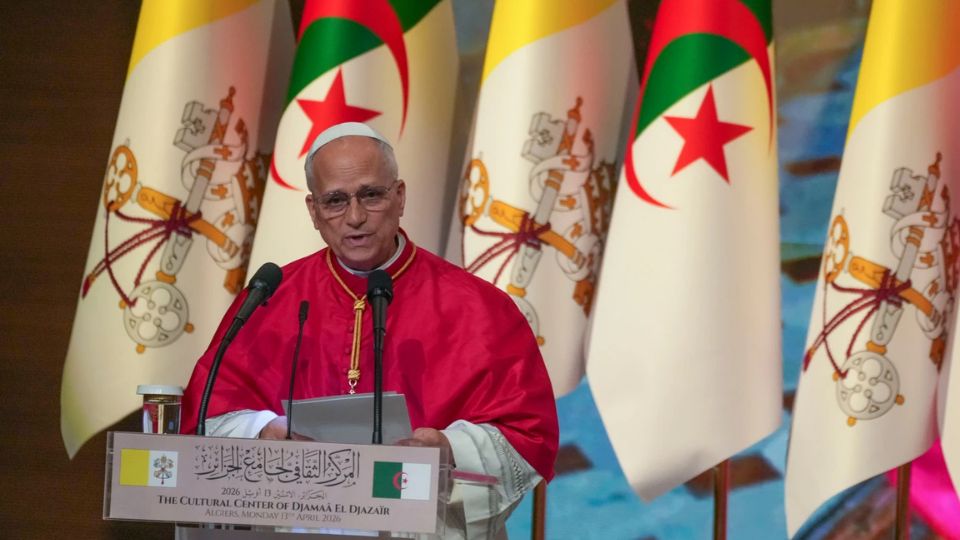
Pope Leo XIV addresses Algerian authorities, members of the civil society, and diplomatic corps at the Djamaa el Djazair Conference Center in Algiers, Monday, April 13, 2026, on the first day of an 11-day apostolic journey to Africa.| Andrew Medichini/AP
Algeria: A Beacon of Stability in the Mediterranean as Pope Leo XIV Visits
In an age marked by geopolitical fragmentation and a crisis of trust among civilizations, Algeria is stepping forward as a stabilizing force in the Mediterranean. The upcoming visit by Pope Leo XIV from April 13 to 15, 2026, is not merely a diplomatic formality but a profound recognition of Algeria’s vital role in fostering dialogue and understanding between cultures.
A Multifaceted Role in Global Dialogue
The significance of Pope Leo XIV’s visit lies in Algeria’s unique capacity to navigate multiple roles: as a sovereign state, a regional stabilizer, and a guardian of rich historical traditions. As Algeria embraces a model of equilibrium between identity and openness, it serves as a critical link between North and South, Islam and Christianity, and between Africa and Europe.
Algeria’s Strategic Importance
The decision to kick off a major African papal journey in Algiers underscores Algeria’s strategic significance on the global stage. Few nations can sustain such multidimensional relevance, and even fewer can do so with the coherence Algeria exhibits.
A Rich Historical Context
The visit takes place against a backdrop of rich intellectual and historical significance. From high-level political meetings in Algiers to a stop at the ancient city of Annaba, the journey encapsulates a geography that is intellectually stimulating as much as it is historically rich.
A Symbolic Visit to the Great Mosque of Algiers
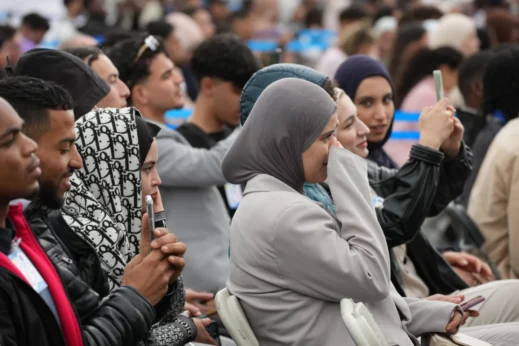
A pivotal moment in the visit will be at the Djamaa El Djazair, the Great Mosque of Algiers. As the largest mosque in Africa, it represents more than just religious devotion; it embodies Algeria’s ability to blend tradition with modernity. The mosque’s remarkable architectural features, including the tallest minaret globally, symbolize the nation’s melding of its historical identity with a forward-thinking vision.
Dialogue in a Complex Landscape
The Pope’s presence at such a significant site signals a commitment to interreligious dialogue, emphasizing that meaningful conversations can occur within the framework of distinct spiritual traditions. Algeria thus presents a model where sovereignty, religious authenticity, and openness coexist fruitfully.
Constitutional Framework Upholding Pluralism
Algeria’s 2020 Constitution strengthens this model, ensuring freedom of conscience while recognizing Islam as the state religion. This balance allows for a recognized plurality within a solid legal framework, thus embodying a unique narrative of identity and openness.
A Journey to Intellectual Roots
The itinerary lends deeper meaning, particularly in Annaba, where Saint Augustine shaped foundational philosophical and theological discourse. His works, like Confessions and The City of God, are grounded in the rich plurality and intellectual vitality of North Africa, emphasizing Algeria’s important role in the evolution of global thought.
Contemporary Relevance and Sovereignty
Algeria’s significance extends beyond its historical narrative. In a region often beset by turmoil, Algeria remains a steadfast proponent of sovereignty and non-alignment, positioning itself as a mediator and actor in regional security, migration, and energy challenges.
The Power of Cultural Synthesis
The country’s rich fabric—woven from Arab identity, Amazigh heritage, and Islamic tradition—functions as a pillar of resilience, facilitating engagement with various civilizational narratives while maintaining a robust core identity.
Conclusion: A Moment of Recognition
As the Pope traverses sites like the Maqam Echahid, he underscores that Algeria’s engagement in global dialogue stems from a history rooted in struggle and sovereignty. The visit is not merely to acknowledge Algeria’s past but to affirm its role as a pivotal player in shaping future cross-cultural conversations. Algeria offers a compelling paradigm of continuity without stagnation, openness without dilution, and identity without exclusion—all contributions that are increasingly vital in today’s interconnected world.
Thus, this visit stands not only as a moment of visibility but importantly, as a long-overdue moment of recognition—profoundly impactful for Algeria and the international community alike.
