

The Complex Geopolitical Landscape Impacting Global Energy Security: A Focus on India and Africa
The ongoing military tensions involving Iran, Israel, and the United States have underscored the significant human toll and the structural vulnerabilities inherent in global economic and energy frameworks. As the conflict escalates, concerns have intensified over potential fallout, especially regarding the closure of the Strait of Hormuz, a vital maritime chokepoint that affects oil and natural gas markets. Major Gulf oil producers have declared force majeure due to a lack of export routes. The US and Israel’s strategy, dubbed “Operation Epic Fury,” aims to limit Iran’s military capabilities through early and targeted strikes to disrupt its leadership. This approach intends to weaken Iran’s ability to retaliate against adversaries.
Iran’s Prolonged Conflict Strategy
Iran’s current strategy prioritizes extending the conflict rather than escalating tensions. By targeting essential infrastructure across multiple Gulf nations allied with the US, Iran seeks to destabilize global maritime trade. Sporadic drone and missile attacks on critical sites, including energy systems and ports in Saudi Arabia, Kuwait, and the UAE, increase operational and economic pressures, thereby coercing the US and Israel to reconsider their military actions. Tehran’s leadership appears committed to leveraging prolonged warfare dynamics to erode political support for conflict in the US and beyond.
India’s Strategic Vulnerability in Energy Security
For India, the unfolding conflict presents significant economic and strategic vulnerabilities. The Strait of Hormuz is crucial; minor disruptions can halt shipping and destabilize global energy markets. Approximately 25 percent of global oil trade, including around 20 million barrels per day, traverses this route. Recent military escalations have already resulted in a steep decline in shipping traffic, which has adversely affected energy markets.
India’s dependence on this route is alarming, as nearly 40 percent of its crude oil imports and 69 percent of LNG supplies transit through Hormuz. The emotional, economic, and security implications of this tension extend deeply into the Indian economy, influencing everything from energy prices to food security.
Rising Energy Prices and Economic Consequences
Amid rising geopolitical tensions, Brent crude prices have surged above $90 per barrel, and shipping costs have soared. The escalation in war-risk insurance for vessels navigating these tumultuous waters has significantly impacted transportation expenses, with premiums doubling. As India relies heavily on maritime routes for 95 percent of its trade by volume, any disruption poses cascading problems throughout its economy.
Strategic Imperatives for India: The Madhyamā Mārga
Given these vulnerabilities, India must adopt a pragmatic approach to navigate an increasingly complex geopolitical environment. The concept of Madhyamā Mārga, or the Middle Path, provides a philosophical framework emphasizing balance and ethical restraint. This strategy enables India to preserve strategic autonomy without rigid alignments, promoting flexible engagement with multiple global partners and minimizing conflict-driven dependency.
Diplomatic Balancing: Depolarization and De-hyphenation
Through pathways of depolarization and de-hyphenation, India can engage with both competing blocs and navigate complex geopolitical rivalries without losing diplomatic flexibility. This strategy facilitates maintaining relationships that can coexist rather than being defined by rivalry.
Africa: Key to India’s Strategic Diversification
Africa is increasingly pivotal for India’s pursuit of strategic autonomy, especially in energy security. By diversifying energy partnerships with African countries rich in natural resources such as oil and gas, India aims to reduce its reliance on conflict-prone regions. Countries like Nigeria, Algeria, and Angola offer significant alternative supply routes, ensuring that India can mitigate supply shocks stemming from instability in West Asia.
The geographical advantages of African energy shipments add another layer of resilience, as these routes face fewer chokepoints and offer logistical efficiency. Moreover, maintaining trade relationships with African nations will help diversify India’s trade networks, enhancing economic stability amid global uncertainties.
Conclusion
In an unstable international landscape, India’s evolving relationship with Africa represents not just an opportunity for energy diversification, but also a step toward a balanced approach in global governance. Both nations share a commitment to principles like cooperation and shared responsibility that align closely with India’s Madhyamā Mārga philosophy. By deepening collaboration across areas such as energy, maritime security, and agriculture, India can emerge as a stabilizing force while simultaneously enhancing its own resilience against global disruptions.
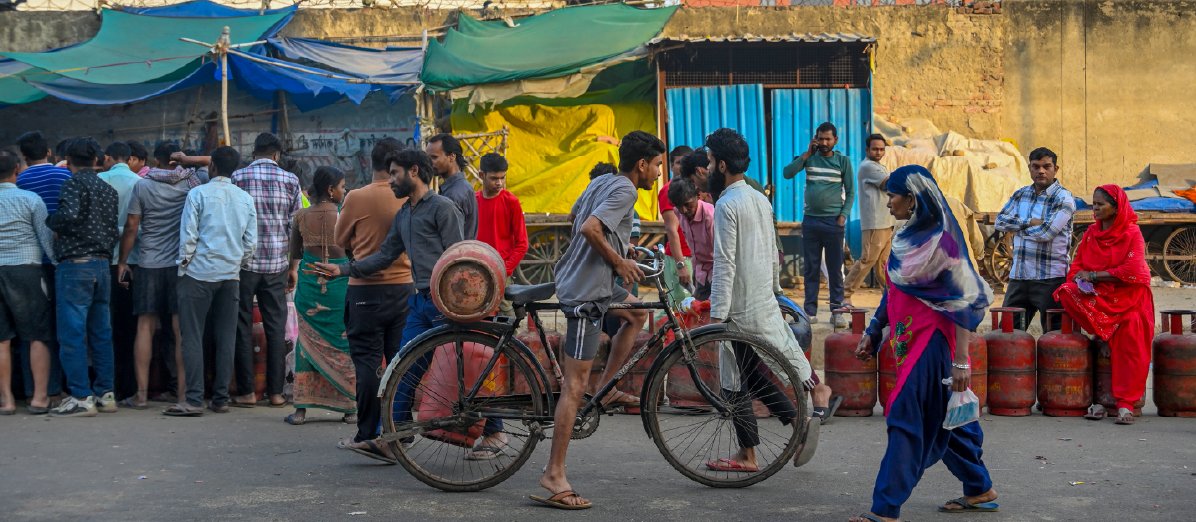
Image credit: People waiting in long queues to obtain a cooking LPG gas cylinder on March 14, 2026 in Noida, India. (Sunil Ghosh/Hindustan Times/Sipa USA vis Reuters)
