

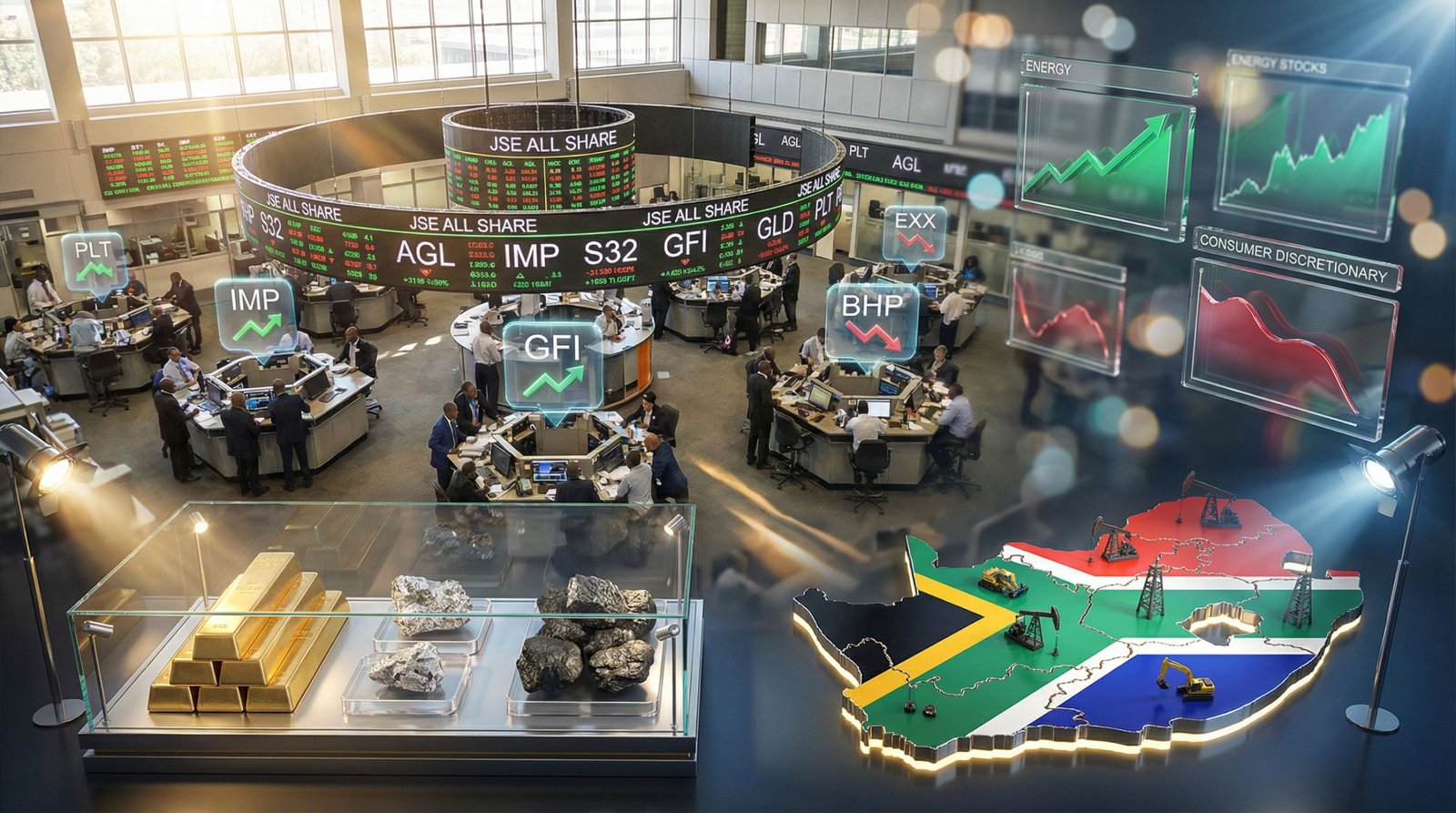
The current gold market trends are heavily shaped by escalating geopolitical tensions in the Middle East. Commodity-dependent emerging economies, particularly South Africa, are witnessing extraordinary transmission of these geopolitical shocks through their interconnected trading networks. The recent conflicts illustrate how localized issues can trigger widespread economic disruptions, exposing the vulnerabilities of resource-heavy markets focused on extraction and export-driven growth.
South Africa’s financial landscape showcases this vulnerability, as its structural dependencies amplify reactions to external turmoil. Notably, the interplay between commodity prices, currency stability, and stock market performance highlights the speed at which investor sentiment can turn amidst international uncertainty.
What Makes South Africa’s Stock Market Vulnerable to Global Conflicts?
Resource-Heavy Index Structure Creates Amplified Volatility
The FTSE/JSE All Share Index’s structure reveals why South Africa faces disproportionate turbulence during geopolitical events. With around 25% exposure to precious metals and mining activities, the index is significantly more sensitive to commodity price fluctuations than more diversified emerging market indices.
This concentration was evident in March 2026, when the South African stock index plummeted by 13%, its steepest monthly decline since the global financial crisis of September 2008. The Middle East conflict triggered a selloff, unveiling the structural weaknesses ingrained in resource-dependent market frameworks.
| Market Segment | JSE Weighting | March 2026 Performance |
|---|---|---|
| Precious Metals & Mining | 25% | -27% |
| Construction & Materials | 8% | -10%+ |
| Banking Sector | 15% | -10%+ |
| Retail & Consumer | 12% | -10%+ |
The mining sector’s dramatic 27% decline during this turmoil highlights how indexed weightings exacerbate volatility in risk-averse periods. Furthermore, ongoing trends in the mining industry indicate that structural changes may continue reshaping market dynamics as global investors withdraw from emerging markets.
The Currency-Commodity Correlation That Drives Market Sentiment
Currency transmission mechanisms significantly influence how external disruptions propagate through South Africa’s financial markets. A surge in oil prices above critical levels, like $100 per barrel during the March 2026 crisis, typically leads to immediate selling pressure on emerging market currencies.
This relationship between rising energy prices and central bank policies creates a feedback loop, particularly affecting commodity currencies. As central banks in developed markets signal tightening in response to inflation, interest rate differentials widen, diminishing the appeal of rand-denominated assets.
- Import cost inflation undermines real purchasing power.
- Current account pressure from soaring import costs weakens the currency.
- Capital flow reversals as investors seek better yields abroad.
- Increased risk premiums during volatile times heighten returns required for emerging market exposure.
The South African Reserve Bank’s recent revisions to inflation forecasts during this crisis indicate a recognition of these transmission channels, hinting at potential monetary policy responses that might further hamper growth. Additionally, heavy losses faced by the Johannesburg Stock Exchange underscore the turbulence fueled by Middle Eastern uncertainties.
Which Sectors Are Winning and Losing in the Current Crisis?
Mining Giants Face the Precious Metals Paradox
The disruptions of March 2026 revealed a deviation from typical safe-haven investment behaviors. Although geopolitics often spike demand for gold, precious metal prices fell amidst the Middle East conflict, defying traditional crisis-related allocations.
This paradox is driven by several conflicting forces:
- Rising real interest rates diminished gold’s appeal as a non-yielding asset.
- Strengthening US dollar made precious metals costlier for international buyers.
- Portfolio liquidation pressure compelled institutional investors to sell liquid assets.
- Deteriorating growth expectations lessened industrial demand for platinum and palladium.
The 27% drop in the precious metals and mining sector erased substantial gains amassed during previous rallies. Companies with significant gold and platinum holdings faced margin squeezes due to both declining prices and increasing energy costs. Following current gold price forecasts indicates that volatility is likely to continue.
Energy Stocks Emerge as Defensive Plays
While most sectors faced substantial declines, energy companies offered some defense during this tumultuous period. The persistence of oil prices above $100 per barrel revealed relative value opportunities within the JSE, particularly for firms with energy direct exposure or cost mitigation capabilities.
Firms like Sasol benefitted from integrated operations, with revenues rising alongside oil price increases that pressured other sectors. Similarly, coal exporters experienced heightened demand owing to European energy security worries, thereby illustrating diverse performance patterns across the resource landscape.
Consumer Discretionary Sectors Under Maximum Pressure
The intersection of escalating energy costs, inflation, and a tightening monetary framework led to particularly adverse conditions for consumer-centric businesses. Sectors such as construction, materials, retail, and banking all dropped by more than 10% in March 2026, showcasing their vulnerability to economic slowdowns and margin contractions.
Banking sector risks extend beyond energy cost impacts to include deteriorating credit quality as consumers grapple with heightened fuel costs and looming interest rate hikes. Mortgage portfolios and consumer credit facilities now face increased default risks as households adjust to inflationary challenges and sluggish growth.
The widespread sectoral declines reflected investor anxieties about both immediate inflationary consequences and longer-term growth prospects for the South African economy.
How Do Geopolitical Shocks Transmit Through Emerging Market Channels?
The Risk-Off Trade Mechanics Explained
Emerging markets exhibit predictable patterns of shock transmission that intensify during global uncertainty. The South African stock index decline exemplifies how Middle East conflicts propagate through intricate financial channels, amplifying effects beyond mere economic exposure.
This transmission generally follows these stages:
- Initial shock recognition as geopolitical events raise uncertainties regarding global growth.
- Commodity price adjustments in response to fears about supply disruptions and demand shifts.
- Currency market reactions as investors reassess the risk premiums tied to emerging markets.
- Repricing equity markets through multiple compression and revisions of earnings expectations.
- Widening credit markets as both sovereign and corporate spreads adjust to perceived increased risks.
In March 2026, this cascading effect intensified as oil prices persisted above $100 per barrel, prompting investors to reevaluate their inflation expectations and responses from central banks globally. Detailed precious metals analyses become vital for understanding these ongoing market dynamics.
Capital Flow Reversal Amplification
The retreat from emerging market equities reflects institutional portfolio rebalancing driven by risk management and changing value assessments. When yields in developed markets rise in response to inflation, emerging market assets must offer higher risk premiums to remain appealing.
This rebalancing results in self-reinforcing downward pressures through various mechanisms:
- Forced selling by funds facing redemption demands or risk tolerances being breached.
- Currency hedging adjustments as institutions aim to reduce their exposure to emerging markets.
- Shifts in liquidity preference toward developed assets during uncertain periods.
- Momentum-driven selling as technical indicators prompt systematic sell-offs.
The significant outflows from South Africa during this timeframe underscored both the country’s vast mining sector exposure and its integration into global emerging market portfolios. Further details show that South Africa’s stock index was on track for its worst month since 2008 amidst the prevailing tensions.
What Does Historical Context Reveal About Recovery Patterns?
Lessons from the 2008 Financial Crisis Comparison
The comparison of the March 2026 decline to that of September 2008 offers crucial insights into the severity of the current selloff and potential recovery avenues. The 13% monthly slump aligns with the steepest declines seen during the global financial crisis, indicating systemic stress of similar magnitude.
However, the underlying causes between these crises differ substantially. While 2008 represented a fundamental breakdown within global financial frameworks, the 2026 turmoil stems from geopolitical uncertainties coupled with commodity price instability. These foundational differences suggest divergent recovery pathways and shifting sectoral dynamics.
The recovery phase observed between 2008 and 2009 in South African markets featured several key attributes:
- Mining sector leadership during initial recovery phases as commodity prices rebounded.
- Currency stabilization typically precedes broader equity market recoveries.
- Sectoral rotations from defensive positions back to growth-focused sectors.
- Valuation-driven purchases as price-to-book ratios reached attractive levels historically.
South Africa’s Previous Commodity Super-Cycle Experience
The recent selloff becomes more significant when viewed against the backdrop of a remarkable 44% rally in the FTSE/JSE All Share Index, marking the longest continuous stretch of monthly gains since record-keeping began in 1995. This surge was fueled by rising metal prices, a strong rand, and declining inflation expectations.
February 2026 alone saw a remarkable 7% gain, the largest monthly rise in over two years, primarily driven by metals and mining stocks. This stark shift from peak optimism to crisis-induced declines vividly illustrates the volatility that characterizes commodity-centric market structures.
The brisk change in sentiment can be attributed to several structural factors, including:
- Momentum-driven investment flows that tend to magnify movements in both directions.
- Commodity price swings swiftly alter earnings expectations.
- Currency correlations compound directional moves.
- International investment sensitivity reflects changing perceptions of emerging market risks.
Moreover, insights into iron ore demand underscore the role mineral sector dynamics play in these volatile cycles.
Which Investment Strategies Make Sense During Prolonged Uncertainty?
Portfolio Rebalancing Considerations for Volatile Periods
The current market climate necessitates careful evaluation of sector allocations and risk management approaches. Conventional buy-and-hold strategies may fall short amidst heightened geopolitical uncertainties and commodity price volatility.
Essential rebalancing strategies may include:
- Minimizing overweight positions in the mining sector to achieve more balanced allocations.
- Augmenting exposure to defensive sectors such as utilities, healthcare, and telecommunications.
- Evaluating currency hedging for international investors with rand exposure.
- Maintaining liquidity to secure cash positions for opportunistic investments.
Investors with a value orientation may discover opportunities among undervalued mining stocks, particularly those boasting strong balance sheets and low-cost operations. However, it is crucial to manage position sizes given the potential for ongoing volatility in the face of extended geopolitical uncertainty.
Contrarian Investment Opportunities in the Selloff
The magnitude of sectoral declines has opened doors for value-seeking investors with longer-term perspectives and suitable risk tolerances. Firms trading below historical valuation multiples may present attractive risk-adjusted returns, provided operational fundamentals remain sound.
Critical screening criteria become paramount during volatile conditions:
- Robust balance sheets characterized by low debt-to-equity ratios and sufficient liquidity.
- Operational flexibility demonstrating adaptability in cost structures and geographic diversification.
- Management quality evidenced by effective handling of crises.
- Strategic positioning that aligns with ongoing growth trends despite cyclical challenges.
Long-term infrastructure investments may find favor from rand depreciation, especially those companies with export capacities or revenue streams in foreign currencies that provide natural hedging characteristics.
How Might Monetary Policy Responses Shape Market Direction?
South African Reserve Bank’s Policy Dilemma
The central bank confronts a complex challenge in balancing inflation control with the need to support economic growth amid external shocks. Rising energy costs exert direct inflationary pressure while also hampering growth prospects due to increased input expenses.
The effectiveness of policy tools may be constrained during these external situations, as interest rate alterations might have limited impact on imported inflation while potentially worsening growth downturns. Recent inflation forecast adjustments by the Reserve Bank point to an acknowledgment of these constraints.
Possible policy responses include:
- Gradual rate hikes aimed at stabilizing inflation expectations without strangling growth.
- Communication strategies designed to align market expectations regarding policy direction.
- Foreign exchange interventions to mitigate excessive rand volatility.
- Coordinated actions with fiscal authorities on counter-cyclical spending initiatives.
Global Central Bank Policy Spillover Effects
Responses from developed market central banks to inflationary pressures yield significant consequences for the actions of emerging market monetary policies. As institutions like the Federal Reserve and the European Central Bank implement tighter policies due to energy-induced inflation, emerging market central banks face diminished policy flexibility.
These effects interplay through various channels:
- Interest rate differentials affecting capital flow patterns.
- Currency pressures necessitating defensive policy adjustments.
- Rising import costs from stronger currencies in developed markets.
- Changes in credit availability as global lending conditions tighten.
Coordinating global monetary policies becomes vital for sustaining stability in emerging markets during prolonged geopolitical uncertainties.
What Are the Longer-Term Structural Implications?
Energy Security Reshaping Investment Priorities
The ongoing crisis may hasten structural shifts within global energy and commodity supply chains, presenting opportunities for South African enterprises strategically positioned within critical mineral value chains. The emphasis on supply chain diversification, moving away from geopolitically unstable regions, could be advantageous for countries with political stability and abundant resources.
South Africa’s wealth in platinum group metals, rare earth elements, and other strategic subsurface resources may increasingly attract attention from developed economies prioritizing supply security alongside cost-control measures. This transformation may bolster the long-term viability of mining sector investments despite current cyclical pressures.
Technology Sector Development as Diversification Strategy
The volatility associated with commodity-centric economic structures accentuates the need for diversification away from mining. The growth of technology sectors, expansion of financial services, and enhancements in manufacturing capabilities represent feasible paths to mitigate dependence on mining performance.
Such diversification demands persistent investment in education, infrastructure, and capacity development. The current crisis may stimulate policy initiatives aimed at accelerating longer-term structural adjustments.
Key Takeaways for Investors and Policymakers
Risk Management Framework for Volatile Periods
Key indicators to monitor include:
- Brent crude oil prices maintaining levels above $100 per barrel.
- USD/ZAR exchange rate support and intervention levels.
- Relative strength of the JSE mining index against global comparators.
- Government bond yield spreads compared to US Treasuries as risk premium indicators.
Investment decision frameworks should integrate scenario analyses, contemplating multiple outcomes for both geopolitical resolutions and economic transmissions.
Policy Response Effectiveness Measures
Pivotal to policymaking in times of external shocks is both the capacity for immediate crisis responsiveness and the facilitation of longer-term structural adjustments. Analyzing fiscal space is vital for determining the feasibility of counter-cyclical spending without jeopardizing currency stability or debt sustainability.
Promoting regional economic integration initiatives may offer additional mechanisms for shock absorption, diminishing reliance on individual national policy responses. This current crisis might expedite discussions surrounding coordination of monetary policies across Africa and diversification of trade relationships.
Critical Investment Metrics During Uncertainty:
- Oil price levels and volatility trends influencing inflation expectations.
- Stability measures of currency and the capacity for central bank interventions.
- Indicators of sector rotation reflecting shifts between defensive and growth preferences.
- Variations in international capital flow directions and policy response effectiveness.
The intersection of geopolitical uncertainties and commodity-dependent economies presents intricate investment challenges necessitating insightful analyses and adaptable strategies. Understanding these transmission mechanisms establishes a strong foundation for successfully navigating volatile periods while identifying prospective opportunities amid disruptions.
Disclaimer: This analysis serves educational purposes and does not constitute investment advice. Geopolitical events inherently introduce unpredictability into financial markets, and past performance does not ensure future results. Investors should conduct thorough due diligence and may consider consulting qualified financial professionals prior to making investment decisions.
Are You Positioned to Capitalise on the Next Major ASX Discovery?
While South African markets highlight the perils of commodity dependence in the face of geopolitical uncertainties, astute investors can still pinpoint opportunities within Australia’s mining sector through timely discovery alerts. Discovery Alert’s proprietary Discovery IQ model provides prompt notifications regarding significant ASX mineral discoveries, assisting subscribers in spotting actionable opportunities before market-wide recognition catalyzes substantial price movements. Begin your 14-day free trial today and secure your competitive edge within Australia’s evolving mining landscape.
