

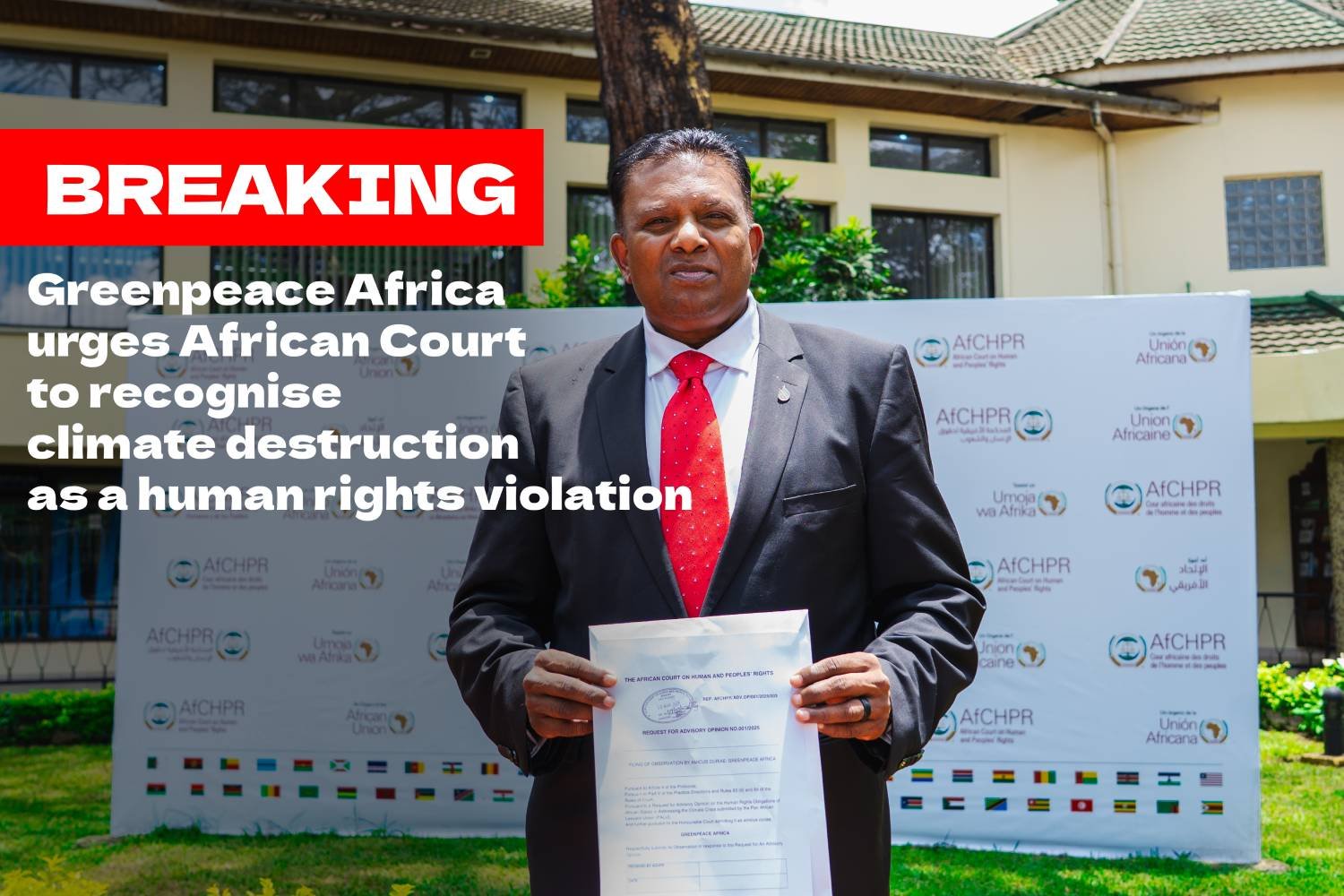
Submission to Africa’s Highest Court: Climate Crisis as a Human Rights Violation
ARUSHA, TANZANIA – In a pivotal move, Greenpeace Africa has presented an amicus curiae brief to the African Court on Human and Peoples’ Rights (AfCHPR), asserting that the ramifications of climate change amount to systematic violations of human rights for the people of Africa.
The brief places the climate crisis within a broader context of extractive economic practices prevalent across the continent. From fossil fuel extraction and mining to deforestation and industrial agriculture, these activities threaten essential rights, including the right to life, health, food, water, and a sustainable environment. Greenpeace emphasizes that governments are obliged under the African Charter to prevent environmental harm, ensure community involvement, and provide remedies to those affected.
Greenpeace Africa argues that permitting multinational corporations to operate without stringent environmental regulations marks a significant betrayal of the State’s responsibilities to safeguard the rights to health and a satisfactory environment.
“This case is about justice for frontline communities already bearing the costs of a climate crisis they are least responsible for,” stated Eugene Perumal, Governance and Legal Advisor at Greenpeace Africa. “Across the continent, communities are facing the fallout from decisions made without their consent. We urge the Court to reaffirm the duty of governments to protect people and to combat ongoing corporate impunity.”
The submission also underscores the escalating risks associated with the rise of industrial livestock farming – a new and rapidly growing issue in the region. Unlike traditional agricultural practices, industrial meat production exacerbates environmental degradation, accelerates deforestation, and transfers control of food systems from local communities to multinational corporations.
A notable case is the planned expansion of JBS, the world’s largest meat producer, into Nigeria. The proposed $2.5 billion investment in industrial meat processing serves as a concerning example of how global agribusiness seeks to penetrate African markets, raising alarms about environmental repercussions, inadequate public consultation, and the long-term effects on local food systems and livelihoods.
JBS has entered a Memorandum of Understanding with the Nigerian government to develop six industrial meat-processing plants, with reports indicating that at least one Nigerian state has committed 1.2 million hectares of land for this initiative. However, the MOU remains undisclosed, and formal requests for disclosure, as well as social and environmental impact assessments, have gone unanswered. Local communities assert they have not been consulted regarding these developments.
Referencing Article 21(5) of the African Charter, which mandates States to “eliminate all forms of foreign economic exploitation, particularly that which is practised by international monopolies,” the brief argues that facilitating corporate expansion in the absence of transparency and community engagement constitutes a breach of governance duties.
The submission draws from the significant precedent set by SERAC v. Nigeria (2001), a case stemming from the detrimental effects of Shell’s oil operations in Ogoniland. This ruling established that states are required to regulate corporate conduct, conduct and disseminate impact assessments, and ensure community engagement before approving major industrial projects. Greenpeace claims that the governance of the JBS agreement by the Nigerian government does not meet any of these established obligations.
Elizabeth Atieno, Food Campaigner at Greenpeace Africa, emphasized:
“The projects being sanctioned today will dictate who controls our land, food resources, and the health of our planet moving forward. We urge the Court to provide a powerful advisory opinion that enshrines the rights of African communities to reject extractive agriculture and sends a clear message to multinational corporations that their era of unregulated operations on this continent is finished.”
Key Arguments Presented to the Court
Greenpeace Africa’s submission asserts that Africa’s climate challenges fundamentally constitute human rights violations, calling on the Court to affirm three key categories of State obligations under the African Charter:
- Substantive obligations: to reduce emissions, preserve carbon sinks, enhance resilience, and provide remedies for existing harms.
- Procedural obligations: to ensure public participation, access to information, and judicial recourse, especially concerning multinational corporations operating within national borders.
- Remedial obligations: to facilitate reparations for climate-related human rights abuses resulting from corporate activities.
ENDS.
Notes to Editors:
Understanding Amicus Curiae Submissions
An “amicus curiae” – Latin for “friend of the court” – refers to a submission by a non-party with pertinent expertise or public interest in the matter at stake. Greenpeace Africa has been accepted as amicus curiae by the African Court on Human and Peoples’ Rights as it evaluates the human rights obligations of African States in light of the climate crisis. This initiative is part of a groundbreaking series of advisory proceedings among the world’s four highest international courts, anticipated to provide landmark rulings on climate and human rights law.
The Significance of SERAC v. Nigeria
Social and Economic Rights Action Center (SERAC) v. Nigeria (2001) represents a critical judgment by the African Commission on Human and Peoples’ Rights, arising from the destructive environmental and social impacts of Shell’s operations in Ogoniland. The Commission determined that Nigeria violated the African Charter by failing to regulate Shell, establishing a positive duty for States to protect communities from corporate damage, as well as the requirement to conduct and share environmental and social impact assessments prior to major industrial developments. This judicial precedent directly relates to the handling of the JBS expansion by the Nigerian government, which falls short of these obligations.
Why This Advisory Opinion Is Crucial
An advisory opinion affirming substantial State obligations in the context of climate change – including the regulation of multinational corporations – would hold considerable legal significance throughout Africa. In Nigeria specifically, it would strengthen civil society’s position to demand transparency regarding the JBS MOU and related impact assessments. More broadly, it would address a critical accountability gap that allows companies like JBS to operate in developing regions with a level of impunity not seen in their home markets.
