

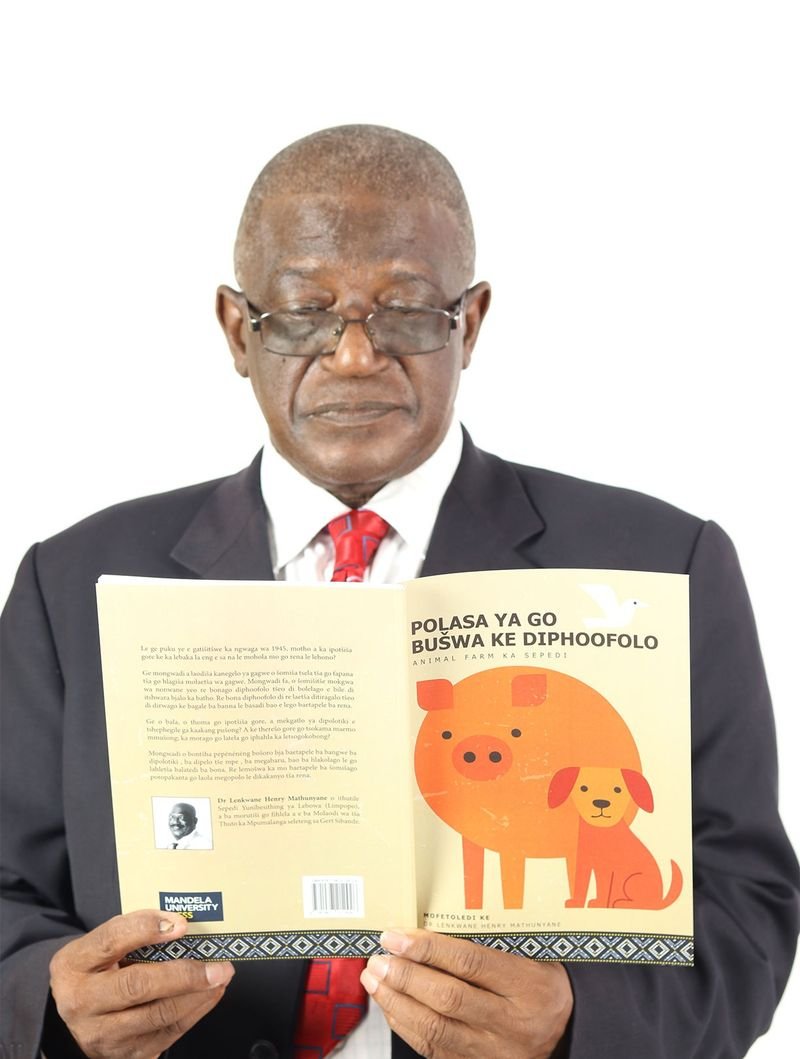
A newly translated Sepedi edition of Animal Farm, George Orwell’s timeless political allegory, has been launched, significantly enhancing access to discussions around power, leadership, and democracy in South African educational settings.
This translation, executed by seasoned educator Dr. Lenkwane Henry Mathunyane and published by the Nelson Mandela University Press, underscores the critical role of multilingualism in fostering political dialogue, critical thinking, and classroom engagement, particularly for learners who are not native English speakers.
The official launch took place on March 26, coinciding with the second Annual Multilingualism Indaba at Nelson Mandela University, held in Gqeberha, Eastern Cape. This three-day event, occurring from March 25 to 27, was themed “Intersections of Knowledge: Language, Multilingualism(s), and Language Policy,” and welcomed scholars, students, and language practitioners to dissect the impact of language on knowledge creation and education.
Advancing Inclusive Education
Professor Pamela Maseko, Executive Dean of the Faculty of Humanities, asserts that the university is “deeply committed to advancing multilingualism as a cornerstone of inclusive and equitable education.” The translation of Animal Farm into Sepedi not only makes classic literature accessible in African languages but also emphasizes its relevance to local cultural, social, and political contexts.
Professor Maseko highlights the potential of African languages to convey intricate ideas, aligning with the institution’s vision of transforming the linguistic landscape in South Africa and addressing the intersections of language, knowledge production, and social justice that the Multilingualism Indaba seeks to illuminate.
Dr. Mathunyane’s work bolsters the literary landscape while enhancing the role of African languages in cultivating informed and engaged citizens. Historically, Animal Farm has been part of the curriculum primarily for English home language learners, leaving second-language students to grapple with the text through linguistic barriers, according to Dr. Mathunyane. He emphasizes that the Sepedi translation promotes equality among learners.
/file/attachments/orphans/Nelson-Mandela-Animal-Farm-Cover_459829.jpg "The Sepedi translation of Animal Farm, published by Nelson Mandela University Press, aims to make the classic political allegory more accessible to South African learners. (Photo: Supplied / Nelson Mandela University)")
“Discussion on topics in politics and governance often remains confined to those studying English literature,” he explains. “This translation allows learners to engage with critical themes in their mother tongue.” This presents an opportunity for students to discuss relevant issues without language constraints.
Language as a Tool for Learning
Dr. Mathunyane’s translation project draws from his extensive experience in South Africa’s education system. With degrees from the University of Limpopo and the University of South Africa, including a doctorate in educational psychology, he has dedicated years to improving learner engagement in various roles within the Department of Education. Consistently, he identified language barriers as a critical issue in educational settings.
“Assessment results from schools highlighted that language often hinders effective communication and comprehension among students from diverse backgrounds,” he notes. “When the language of instruction is a challenge, students struggle to participate meaningfully.”
This insight inspired Dr. Mathunyane to champion access to literature in multiple languages, believing that students need relatable books both in school and their surroundings.
Relevance of Animal Farm
Originally published in 1945, Orwell’s Animal Farm chronicles the attempts of farm animals to create an egalitarian society, only to be thwarted by the oppressive leadership of the pigs. The story serves as a powerful metaphor for the betrayal of revolutionary ideals, echoing concerns about governance that remain pertinent today.
Dr. Mathunyane observes, “The experiences within the book mirror the daily realities faced by many South Africans.” He cites characters like Napoleon and Squealer as reflections of real-world leaders, affirming that access to this narrative in Sepedi allows broader discussions on political themes.
“Political engagement is increasingly essential. This translation of Animal Farm enables learners to address complex issues regarding power and leadership openly,” he continues, highlighting the project’s goals of showcasing Africa’s linguistic capabilities in expressing sophisticated political concepts.
A Collaborative Translation Journey
Dr. Mathunyane chose to translate the novel into Sepedi as it is his first language and part of his academic focus. “Sepedi students will feel validated having a celebrated English novel available in their language,” he states, emphasizing equality in education.
The translation process was painstaking, extending over ten years to capture the original text’s satire and political nuance. Dr. Mathunyane worked diligently with Sepedi educators and subject advisors to refine a consistent translation, reflecting his dedication to quality.
Ultimately, the manuscript found publication with Nelson Mandela University Press, with the book officially released in January 2026.
Fostering Debate and Critical Engagement
Though presented as a children’s book, the Sepedi edition of Animal Farm is poised to resonate significantly with secondary school and university students. While historically intended for grades 10 to 12, primarily targeting English-speaking students, Dr. Mathunyane emphasizes that second-language learners deserve equivalent opportunities.
Engaging with the text in Sepedi may empower students to delve into the book’s political dimensions with greater confidence. This linguistic accessibility can encourage lively discussions and debates in an inclusive environment.
Furthermore, Dr. Mathunyane envisions creative applications for the text in educational settings. He suggests potential dramatizations of scenes from the novel, which could facilitate deeper understanding of concepts like social justice and equality. He advocates for the creation of multilingual literary societies and debate clubs, reinforcing the message that proficiency in a second language should not diminish anyone’s worth or contributions.
“Every citizen deserves the opportunity to participate and contribute across all aspects of society,” Dr. Mathunyane concludes, calling for a more inclusive approach in educational settings. DM
