

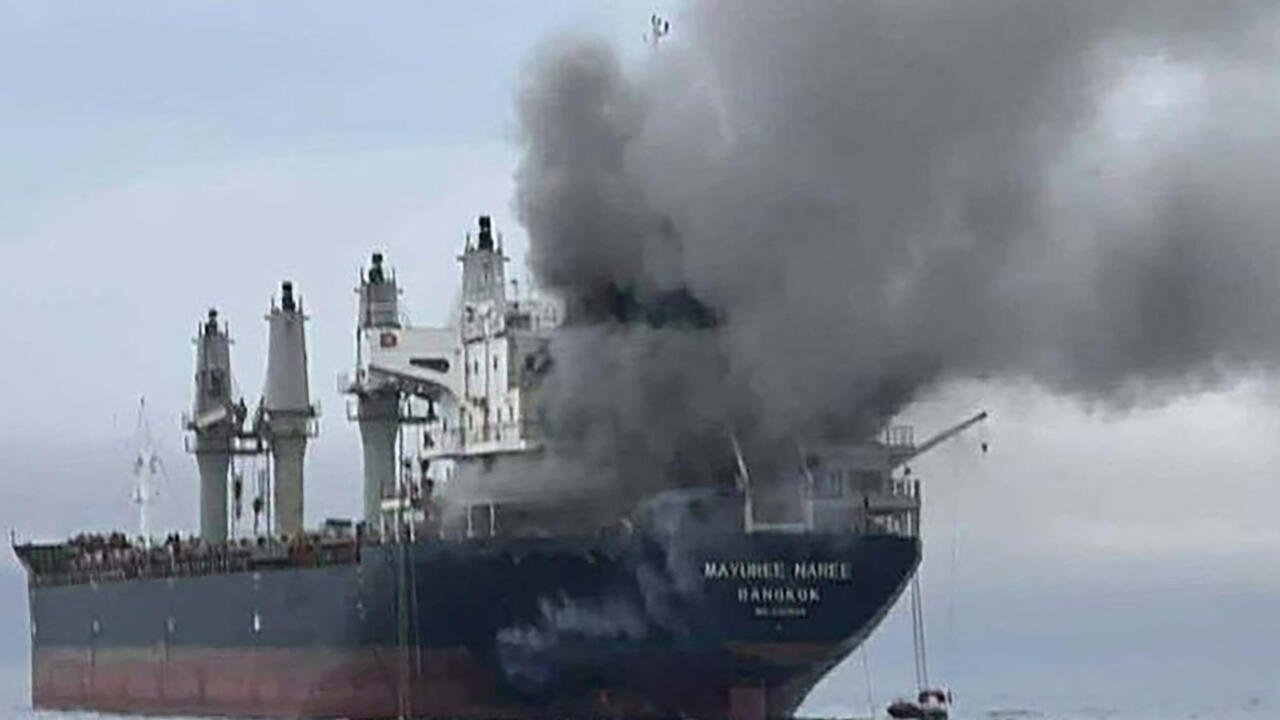
Paris (France) (AFP) – The recent surge in attacks on commercial vessels in and around the Strait of Hormuz has escalated tensions in the region, placing the crucial waterway—an artery for global trade—at the forefront of a deepening Middle East conflict with serious economic implications.
Issued on:
3 min Reading time
In a strategic move to impose economic strain in response to US and Israeli military actions, Iran has effectively blocked the Strait of Hormuz, a passage through which around 20% of the world’s oil and liquefied natural gas (LNG) is transported.
On Saturday, US President Donald Trump called on nations dependent on oil shipments via the Strait to assist in maintaining safe passage, asserting American support in these efforts.
Recent Vessel Attacks
The conflict has seen attacks on at least ten oil tankers, with various reports confirming hits or targeting of vessels since hostilities commenced. Data compiled by UK Maritime Trade Operations (UKMTO), alongside inputs from the International Maritime Organization (IMO) and regional authorities, outlines a worrying trend.
Notable incidents include attacks on the vessels: Skylight, MKD Vyom, Hercules Star, Ocean Electra, Stena Imperative, Libra Trader, and Sonangol Namibe, as reported by the UKMTO. In addition, threats were validated by Iraq’s State Oil Marketing Organization regarding strikes on the Safesea Vishnu and Zefyros.
Commander Alireza Tangsiri of the Islamic Revolutionary Guard Corps (IRGC) claimed responsibility for drone strikes on the Prima and the Louis P, asserting that they also targeted the Athe Nova, a tanker specializing in asphalt and bitumen.
Independent verification of these claims by AFP remains unachievable due to ongoing conflict conditions.
Widening Impact on Maritime Operations
The UKMTO indicated that “at least twenty maritime incidents” involving both commercial vessels and offshore platforms have been documented across the Gulf, Strait of Hormuz, and Gulf of Oman, showcasing the extensive impact of the ongoing conflict.
Interestingly, there is “no consistent pattern of Western ownership” among the vessels affected. This suggests a broader strategy aimed at maritime disruption rather than selective targeting of specific vessels, corroborated by information from the Western-led Joint Maritime Information Center (JMIC).
Escalating Threats and Military Actions
Iranian officials have issued contrasting statements regarding the situation in the Strait. On March 3, a senior IRGC general threatened to “burn any ship” attempting to navigate the strait while contrarily, Foreign Minister Abbas Araghchi affirmed Iran’s lack of intention to close the passage just days later.
In a striking announcement, naval commander Tangsiri emphasized via social media that all vessels intending to traverse the region must seek authorization from Iran.
Additional statements from the Iranian military declared that vessels belonging to the US, Israel, or their allies would be legitimate military targets, emphasizing Iran’s commitment to blocking oil exports from the Gulf.
International Responses and Preventive Measures
In response to the escalating threat, the Pentagon has confirmed the destruction of 16 Iranian mine-laying vessels that could impede navigation through the strait. However, the risk remains high as drone and missile attacks on ships continue.
Following US airstrikes on Iranian military facilities on Kharg Island, which is crucial to Iran’s oil exports, President Trump has publicly warned that he might reconsider his approach concerning the safeguarding of shipping lanes in the Strait.
Meanwhile, French President Emmanuel Macron has urged other G7 leaders to take immediate action to restore safe navigation through this vital waterway, highlighting the global interest in maintaining the flow of crucial energy resources.
© 2026 AFP
